+91 - 9877098771

 ‣Blogs
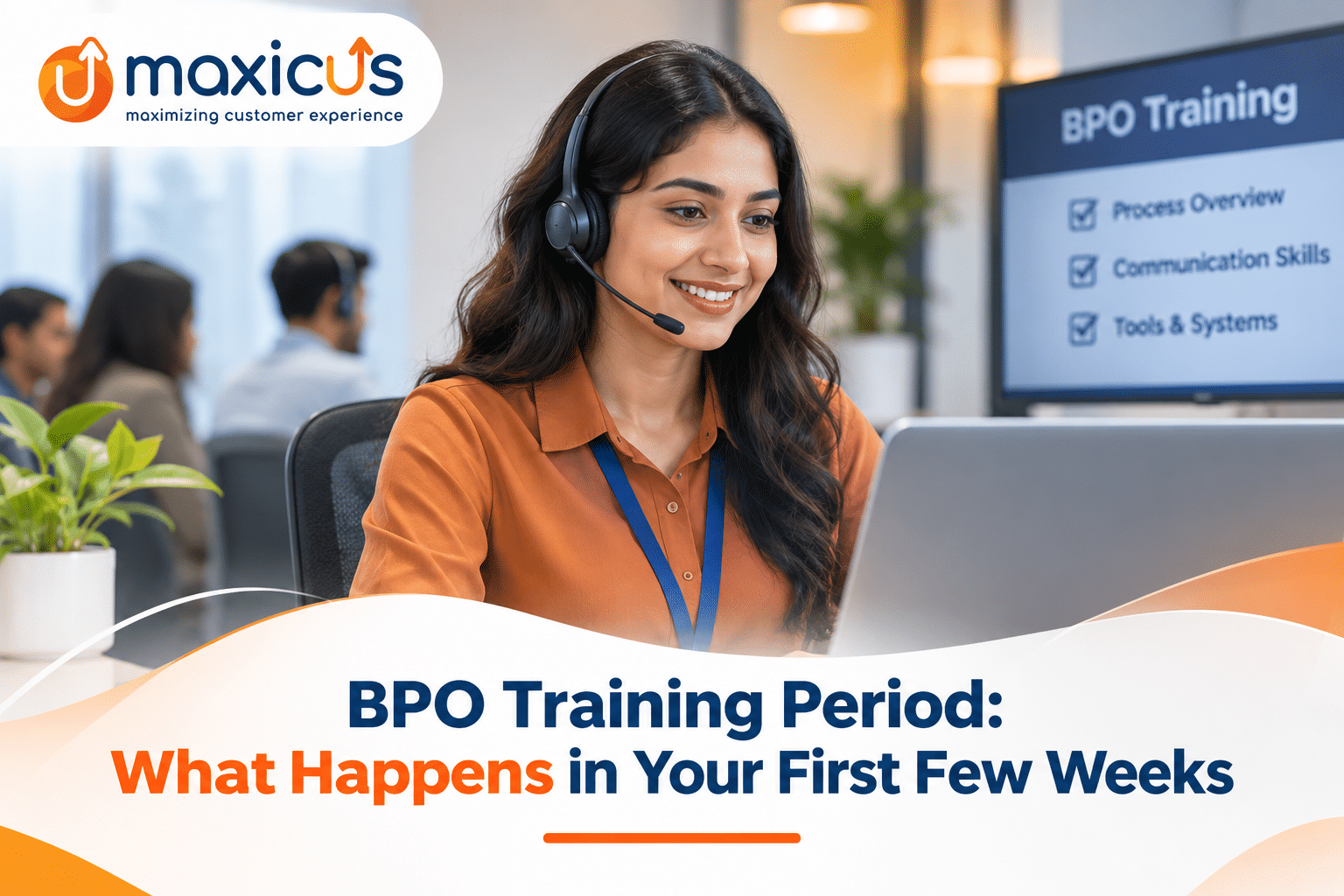
BPO Training Period: What Happens in Your First Few Weeks
You got the job. Now a new question hits: what happens on day one?
Most freshers worry about the same things. How long is training? Will I be thrown onto live calls? What if I fail? This guide answers all of it in plain English, so you walk in calm instead of nervous.
Quick answer: The BPO training period is the time after you join when you learn the process, tools and communication skills before taking live customers. Sources put the initial training at about 1 to 6 weeks (Bright Pattern), and the full ramp-up, including shadowing and nesting, at about 4 to 10 weeks (ScreenSteps). The exact length depends on the company and the process.
Table of content
- What the BPO training period is
- How long BPO training lasts
- The BPO training process, stage by stage
- What nesting in BPO means
- What a training schedule can look like
- What you will learn
- Is BPO training paid?
- How to prepare before day one
- How to do well in training
- Common mistakes
- FAQs
What is the BPO training period?
The BPO training period is the time between joining and handling customers on your own. Companies also call it induction, new hire training or classroom training.
Why does it exist? Because every process has its own product, rules and tools. A good start protects the customer and you.
At Maxicus: Our interview process guide says new employees get training to understand their roles, responsibilities and company policies. Freshers are welcome. Prior BPO experience helps, but it is not required.
How long does BPO training last?
There is no single number that fits every company. But the industry gives us a useful range:
- Initial training: about 1 to 6 weeks (Bright Pattern).
- Full ramp-up, including classroom, shadowing and nesting: about 4 to 10 weeks (ScreenSteps).
- Feeling truly confident: this takes longer. Sources describe months of live work, and some call centers see 4 to 6 months before agents are fully proficient (ScreenSteps, Bright Pattern).
The length depends on how complex the process is, how many tools you must learn, and what the client requires. A simple process may need less time than one with several systems and rules.
Training timeline at a glance:
One published training guide breaks a new-hire program into phases (ScreenSteps):
• Orientation: 1 to 3 days
• Classroom or virtual training: 14 to 60 days
• Shadowing: 1 to 2 weeks
• Nesting: 1 to 3 weeks
These ranges overlap and programs differ, so do not add them up. Use them as a guide, not a rule.
For a real-world example, one India BPO employer publishes a 30-day roadmap for new hires: onboarding in week one, skills and tools in weeks two and three, and nesting in week four.
The takeaway: expect a few weeks of structured learning before you are fully on your own, and plan your life around that.

The BPO training process, stage by stage
Most BPO training follows the same basic path. The details differ by company and process, so treat this as a map, not a promise.
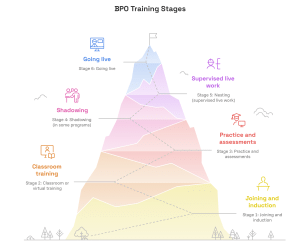
Stage 1: Joining and induction
You complete joining formalities and learn company policies.
At Maxicus: Induction and onboarding includes completing formalities, an introduction to company policies and the issuance of your offer letter. Read the full steps in our interview process guide.
Carry your documents. If you are unsure which ones, check our BPO job eligibility guide.
Stage 2: Classroom or virtual training
This is where you learn the job. It can be in a classroom, online, or a mix of both (ScreenSteps). Expect three things:
- Communication: how to greet, listen, explain and close.
- Tools: the systems you will use to look up and log customer details.
- Process knowledge: the product, the policies and the common issues.
At Maxicus: Freshers are trained on communication, tools and process knowledge from day one. Our onboarding covers the fundamentals of customer experience and digital-first business processes.
Stage 3: Practice and assessments
Training is not just listening. You practice, and you get tested. Most call centers require new agents to pass an assessment to graduate from training (ScreenSteps).
Many programs also use role play and mock calls or chats to check how you handle real situations.
At Maxicus: Training modules use points-based quizzes, badges and leaderboards. See how it works in our post on gamified training at Maxicus.
Stage 4: Shadowing (in some programs)
Some programs add a shadowing step. You sit with an experienced agent and watch real contacts before you take any yourself. Some companies treat shadowing as its own phase, and others fold it into nesting.
Stage 5: Nesting (supervised live work)
After classroom training, you start handling real customers with extra help nearby. More on this in the next section.
Stage 6: Going live
You handle contacts on your own. Your team leader coaches you, and a quality analyst reviews a sample of your calls or chats and gives feedback. Our BPO terms guide explains the numbers you will hear, like AHT, CSAT and FCR.
What does nesting in BPO mean?
Nesting is the period right after formal training, when you take live customers with more support than usual (Call Centre Helper).
Here is how it usually works:
- Experienced agents or supervisors stay close to help.
- Your responsibility grows step by step.
- Your performance is tracked, for example handle time, customer satisfaction and accuracy.
- You leave nesting when you show steady skill and confidence.
Think of it as a practice drive with an instructor next to you. You are on the real road, but you are not alone.
Nesting period in BPO: This is how long the supervised phase lasts. One training guide puts it at about 1 to 3 weeks (ScreenSteps), though it varies by company and process.
Other names: Some companies call this phase on-the-job training (OJT) or a shadowing phase (Call Centre Helper).
What helps in nesting:
- Ask questions right away, not later.
- Note every mistake and what fixed it.
- Do not wait for the feedback session. Ask for it.
What can a BPO training schedule look like?
Here is an illustrative day. Real schedules differ by company:
- Morning: A module on the process or product.
- Midday: Tools practice or a communication session.
- Afternoon: Role play, mock calls and a short quiz.
- End of day: Doubt clearing and a quick recap.
Training hours may also differ from your later shift, so plan your sleep and travel for both. If your process has night shifts, read our guide on night shifts in a BPO so you know what to expect.
What will you learn in BPO training?
You will usually cover:
- Communication skills: tone, clarity, active listening and closing the call. Our communication skills guide helps you prepare early.
- Process and product knowledge: what the customer is calling or writing about, and how to fix it.
- Tools and systems: where customer details and past contacts are stored.
- Company policies: rules for conduct, attendance and data safety.
- Service metrics: what AHT, CSAT and FCR mean for you. See our entries on average talk time, CSAT and first call resolution.
- Handling hard moments: angry callers, escalation and when to ask for help.
Want to see what the job looks like after training? Read a day in the life of a customer support executive and our customer care executive job description.
Is BPO training paid?
Practices differ from company to company. Some employers treat you as a full-time employee from day one and pay your regular salary during training. A published new-hire guide from one India BPO employer says exactly this. Other companies may handle it differently, so do not assume.
Before you accept an offer:
- Read your offer letter for the training terms.
- Check your joining date and training dates.
- If something is unclear, get it in writing before you sign.
How to prepare before day one
A little prep makes week one much easier.
- Learn the basic terms. Start with our BPO terms guide.
- Practice speaking. Read aloud for 10 minutes a day and record yourself once.
- Check your commute and shift. Know your travel time and timings before you start.
- Sort your sleep. Training days are full. Get used to the shift hours early.
- Carry your documents and a notebook. Take notes by hand, they help later.
- Know the voice and non-voice difference. Our voice vs non-voice guide clears it up.
Still unsure the job is right for you? See how to check if you are fit for a customer service job.
How to do well in BPO training
- Take notes. Write down steps, rules and examples. You will use them on live calls.
- Ask questions. Trainers expect them. Silent confusion costs you later.
- Treat quizzes as practice. They show you what to revise.
- Learn the passing rules early. Know what the assessment expects so nothing surprises you.
- Practice out loud. Say your greetings and closings until they feel natural.
- Be on time, every day. Attendance is part of how you are seen.
- Take feedback calmly. It is free coaching, not a verdict.
Training can feel intense. Our post on how to work without stress in call center jobs has practical tips.
Common mistakes freshers make
- Treating training as a formality. It is where you learn the job.
- Skipping notes. Memory fades fast in a busy week.
- Staying quiet when confused. Ask the same day.
- Cramming only for the quiz. Understand the process, do not just memorize.
- Ignoring rest. Tired agents make more mistakes.
Training does not stop after week one
At Maxicus: Growth does not stop at onboarding. We offer technical and soft skills training, mentorship and clear career paths. Executives commonly move into team lead, quality analyst, trainer or operations roles within a few years of consistent performance.
See where the path leads in our guides on the BPO career path from fresher to team leader and how freshers grow into leaders at Maxicus.
FAQs
Q: How long is the BPO training period?
Sources put initial training at about 1 to 6 weeks (Bright Pattern) and the full ramp-up, including shadowing and nesting, at about 4 to 10 weeks (ScreenSteps). The exact length depends on the company and the process.
Q: Is BPO training paid?
It differs by company. Some employers pay your regular salary during training from day one. Check your offer letter for the training terms before you join.
Q: What is nesting in BPO?
Nesting is the period right after formal training when you handle real customers with extra support from experienced agents or supervisors (Call Centre Helper). It usually lasts about 1 to 3 weeks (ScreenSteps).
Q: What happens in BPO training?
You learn communication skills, the process, the tools and company policies. You also practice and take assessments before going live.
Q: Do I need experience to join BPO training?
No. At Maxicus, freshers are welcome and trained on communication, tools and process knowledge from day one. Prior BPO experience helps but is not required.
Q: What if I do not pass a training assessment?
Most call centers require new agents to pass an assessment to graduate from training (ScreenSteps). What happens next differs by company, so learn the passing rules early and treat every quiz as practice.
Q: Is BPO training in a classroom or online?
Both exist. A common training guide describes classroom and virtual training, often mixed (ScreenSteps).
Q: What should I bring on day one?
Bring your documents, a notebook and a pen. Our eligibility guide lists the usual documents.
Q: Is the training the same for voice and chat jobs?
The basics are similar: communication, process and policy. The tools and skills differ. See our voice vs non-voice guide.
Ready to start your BPO journey?
Practice your answers with our 25 BPO interview questions, polish your resume, or see what to expect at a walk-in interview. Then browse customer support jobs and start your career with us.
Share: