+91 - 9877098771

 ‣Blogs
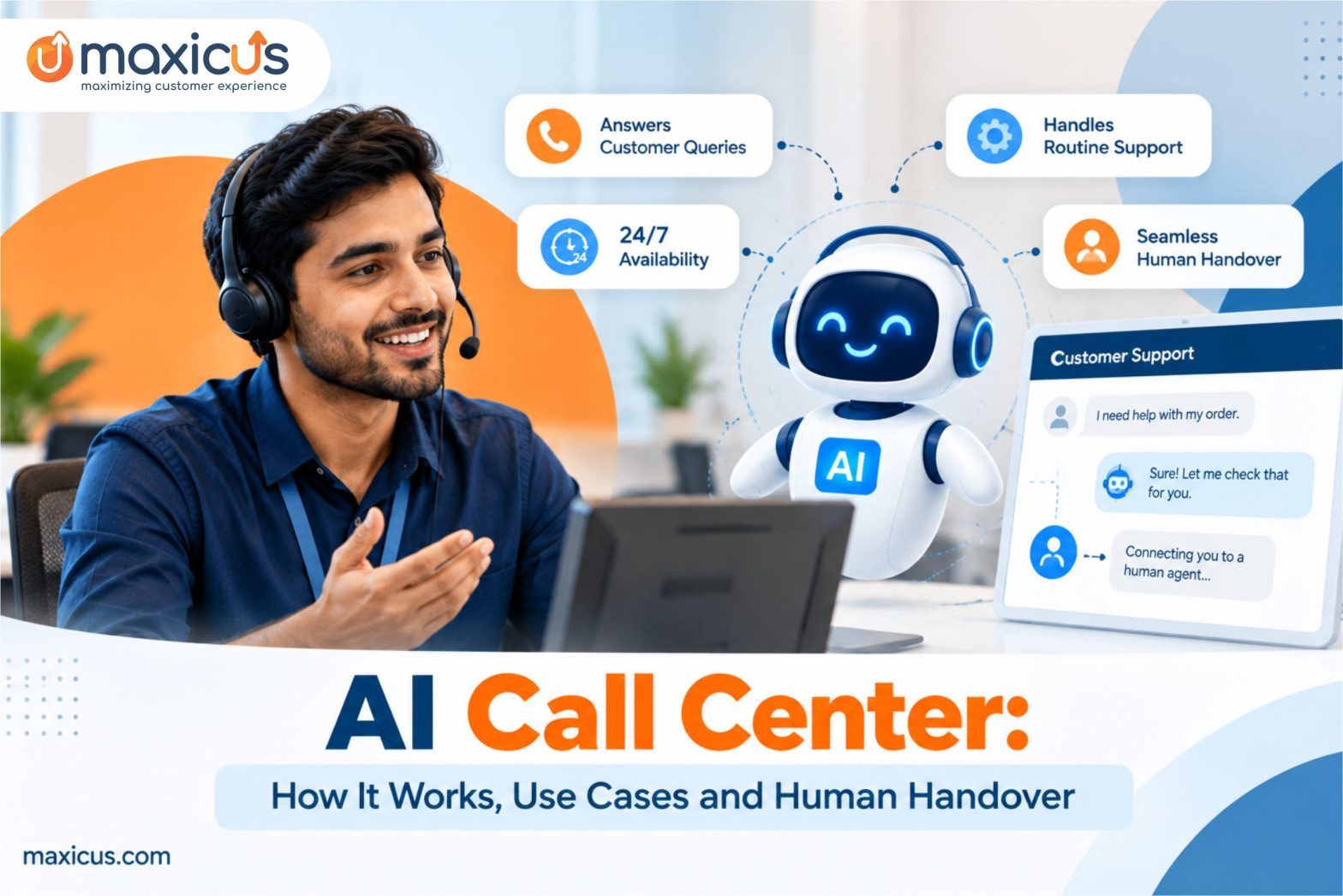
AI Call Center: How It Works, Use Cases and Human Handover
An AI call center uses speech recognition, language understanding and automation to answer routine calls, help human agents during live calls, and review conversations afterward. The AI handles simple, repeatable requests. Anything complex, sensitive or emotional goes to a person, with the full context attached.
That last part matters more than most buyers expect. In a survey of 5,728 customers fielded in December 2023 (Gartner), 64% said they would prefer that companies did not use AI for customer service. The top worry was that AI would make it harder to reach a real person.
So the number is not a reason to avoid AI. It is a design brief. Build the handover well and the rest gets easier. This guide covers how an AI call center works, where it fits, and how to hand a call to a human without the caller feeling dropped.
Table of Contents
- What is an AI call center?
- How a call flows from ring to resolution
- The three seats of an AI call center
- What the data says
- AI call center use cases
- Human handover: where an AI call center wins or loses
- How we build it at Maxicus
- Before you start: seven questions to ask any provider
- Will AI replace call center agents?
- FAQs
What is an AI call center?
Think of a regular call center with three new teammates who never get tired. One answers the phone, one whispers helpful tips to your agents, and one listens to recorded calls and flags what needs fixing.
That is different from the phone menus most of us know. A classic IVR says “press 1 for billing.” An AI call center lets the caller speak normally, understands what they want, and can act on it. You will also see it called contact center AI, conversational AI or voice AI. The ideas overlap.
How a call flows from ring to resolution
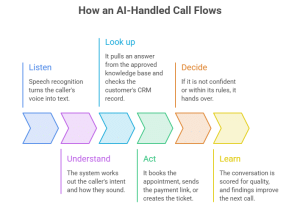
Here is what happens behind the scenes in a typical AI-handled call:
- Listen. Speech recognition turns the caller’s voice into text, including accents and informal phrasing.
- Understand. The system works out what the caller wants (their intent) and how they sound (calm, rushed, upset).
- Look up. It pulls an answer from your approved knowledge base and checks the customer’s record in your CRM.
- Act. It books the appointment, sends the payment link, or creates the ticket.
- Decide. Is it confident, and is this within its rules? If not, it hands over.
- Learn. The conversation is scored for quality, and the findings improve the next call.
Steps 3 and 5 are where good systems separate from frustrating ones. Answers should come from content you approved, not from guesswork. And the “decide” step needs clear rules, which we cover in the handover section below.
The three seats of an AI call center
Most articles treat AI as one chatbot on the phone. A more useful way to see it is three seats, each with a different job.
Seat 1: The front desk
The AI talks to the customer directly. It handles the calls that are routine and repeatable, such as appointment bookings, reminders, order status and FAQs. At Maxicus, this is the job of our AI voice bot. For a closer look at how it fits Indian customer support, read our guide to the AI voice bot for customer support in India.
Seat 2: The co-pilot
The AI sits beside a human agent during the call, surfacing answers, summarizing the customer’s history and suggesting next steps. This seat has the strongest published evidence. In a study of 5,179 customer support agents (NBER), a generative AI assistant raised productivity, measured as issues resolved per hour, by 14% on average. The gain was 34% for novice and lower-skilled workers, and minimal for experienced ones.
That pattern is useful. AI help works like a fast start for new agents, which is also why it pairs well with strong training.
Seat 3: The back office
The AI reviews calls after they end. Instead of a team sampling a small slice of calls, AI can score conversations for quality, compliance and sentiment, with people reviewing the flagged ones. Our QMS and sentiment analysis service works this way.
You do not need all three seats on day one. Most teams start with one.
What the data says
A few numbers help set realistic expectations. Each comes from a primary source we checked.
- Labor is the big cost. Labor can account for up to 95% of contact center costs (Gartner, 2022), which is why automation gets so much attention.
- Adoption was small, and was forecast to grow. In 2022, Gartner estimated that about 1.6% of agent interactions were automated with AI and forecast one in 10 by 2026. That is a forecast, not a measured result, so treat it as direction rather than fact.
- India expects fast change. In a survey of 6,500 service professionals across 40 countries, with 300 in India, fielded April to June 2025 (Salesforce), Indian teams estimated that AI handles about 30% of service cases today and expect 50% by 2027. These are self-reported estimates from a vendor survey.
- Security slows things down. The same survey found that half of Indian service leaders say security concerns have delayed or limited their AI projects.
Put together: the opportunity is real, the pace is uneven, and customers want an easy path to a person.
AI call center use cases
AI works best on calls that are frequent, predictable and low risk. Common examples:
- Lead qualification. Ask a few screening questions and pass warm leads to sales, around the clock.
- Customer support. Answer common questions and route the rest to the right place.
- Appointment coordination. Check availability, confirm, reschedule and send reminders. This is common in healthcare and service scheduling.
- Payment reminders. Remind customers about EMI dues and send a payment link.
- Candidate screening. Run a first-round conversation and capture basic details for recruiters.
These patterns show up across industries, including BFSI, healthcare, e-commerce and telecom.
One tip: pick a single call type to start. Choose the one with high volume and low emotional stakes. Prove it, then expand. For more ideas, read how AI is changing customer service.
Human handover: where an AI call center wins or loses
Handover is the moment the AI says, “Let me bring in someone who can help.” Done well, it feels like a relay race. Done badly, it feels like being put on hold in a maze.
Six moments the AI should step aside
- The caller asks for a person. Say yes the first time. Never make them ask twice.
- The AI is not confident. If it cannot be sure what the caller means, it should say so and hand over.
- The caller sounds upset. Sentiment signals such as frustration or distress are a cue for a human voice.
- The decision is sensitive. Refunds, disputes, complaints and anything with legal or financial weight need human judgment.
- The same question fails twice. A loop is a signal, not a feature.
- The situation is urgent or vulnerable. Health scares, safety issues and similar calls should go straight to a person.
What a good handover carries
A warm handover means the human agent sees what happened before saying hello: why the customer called, what the AI already tried, the customer’s details and history, and their mood. The caller should never have to repeat themselves.
This is the idea behind blended AI: the AI sorts the query, passes the customer to the right agent, and shares what it learned from the current conversation, past interactions and CRM data.
A cold handover does the opposite. The customer is transferred and starts over. That is the experience behind the Gartner concern above.
Measure it, too. First call resolution and customer satisfaction after a handover tell you far more than “how many calls the AI handled.”
How we build it at Maxicus
Our Max AI suite is our own platform for human and AI working together. It has five product lines: AI agents, conversational chat bots, video bots, content generation and walled-garden LLMs.
Under the hood, it combines a few pieces:
- Agentic AI that can plan and run multi-step tasks, not just answer questions.
- Retrieval from your knowledge base before it responds, so answers start from your approved content. This reduces made-up answers.
- Language understanding built for regional language and informal phrasing, including Hindi and other Indian languages.
- Connections to your CRM, databases and ticketing tools, so the AI can take action.
On the human side, queries that fall outside the AI’s authority or confidence threshold pass to a human agent with context intact. Sensitive decisions use human-in-the-loop approvals, and quality audits keep people in the loop too.
If you want people and AI under one roof, see our call center outsourcing services.
Before you start: seven questions to ask any provider
- What can it do, not just say? Can it book, update and create tickets, or only talk?
- What are the handover rules? Ask to see them. Ask what the agent sees on screen.
- How does it handle your callers? Test with real call recordings, with your accents, languages and background noise.
- What does it connect to? CRM, helpdesk, telephony and ticketing.
- How is data protected? Ask about access controls, audit trails, certifications and where data is stored.
- How will you measure success? Look at resolution and satisfaction, not only automation rate.
- What is the pilot? One call type, a clear time frame and a plan to review.
Will AI replace call center agents?
Not in the way the headlines suggest. The evidence points to a shift in the work. The NBER results show AI helping agents resolve more issues, with the biggest lift for newer staff. Even Gartner’s forecast put automated interactions at about one in 10 by 2026, which leaves most conversations with people.
Our view, which is an opinion and not a statistic: routine calls will shrink, and the calls that reach humans will be harder and more emotional. That makes training, coaching and empathy more valuable, not less. Our piece on generative AI in BPO goes deeper on this.

FAQs
Q: What is an AI call center?
It is a call center that uses AI to answer routine calls, assist human agents and review conversations. People handle the complex or sensitive calls.
Q: How is it different from IVR?
IVR uses menus and keypad options. An AI call center understands natural speech and can complete tasks.
Q: Can AI handle calls without humans?
For simple, low-risk calls, yes. For complex, sensitive or emotional calls, a human should step in.
Q: When should AI hand over to a human?
When the caller asks, when the AI is unsure, when the caller is upset, when the decision is sensitive, when the same question fails twice, or when the situation is urgent.
Q: Does an AI call center work in Indian languages?
Our Max AI language layer is built for Hindi and other Indian languages, and our voice bot is multilingual. Contact us for the current voice language list for your use case.
Q: Where should we start?
Start with one high-volume, low-risk call type, set clear handover rules and review results before expanding.
See it on your own calls
Want to see how an AI call center would handle your top call types? Talk to our team or try our AI voice bot.
Share: