+91 - 9877098771

 ‣Blogs

How Better Product Education Improves the Ecommerce Customer Experience
In a store, you pick the product up. You turn it over. You ask the person next to you, “Will this suit my kitchen?”
Online, you get a few photos, a price and a list of specs. Product education fills that gap. It is the information that helps you understand a product before you buy it.
Quick answer: Product education is the information that helps you understand what a product does, who it suits, what it lacks and how it compares. When it is clear and honest, shoppers choose the right product faster, feel less doubt and trust the seller more. Buying guides, comparisons, live video demos and responsive support all help.
Table of Contents
- Why product education matters when you shop online
- What good product education looks like
- Seeing the product first: live video shopping
- Buying a home appliance? Five steps to educate yourself
- Red flags in product information
- What online brands should do
- FAQs
Why product education matters when you shop online
Online shopping gives you choice, but choice without guidance is tiring. Ten air fryers look the same. Five water purifiers use the same letters, and nobody explains them.
Without good information, three things tend to happen:
- You guess. You pick on price, looks or the loudest review.
- You hesitate. You open ten tabs, compare nothing properly and leave without buying.
- You regret. The product arrives, and it is too big, too weak or the wrong type for your home.
Product education turns specifications into answers. A spec sheet says “1,500 watts.” Good education tells you what that means for your kitchen. It also saves you from searching across five websites for basic facts.
What good product education looks like
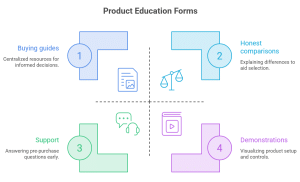
It usually comes in four forms. The best brands and sites use all four.
Buying guides
A buying guide gathers what you need in one place: which features matter, which do not, and what to check for your budget and home. A good one is written for decisions, not just for describing features. Sites such as Gizmo Smart publish buying guides for everyday home appliances, from air fryers and kitchen chimneys to water purifiers and smart locks.
Honest comparisons
When models look alike, a comparison explains what actually differs. Take a smart lock. You may need to compare unlock methods, battery backup and installation. The useful comparison explains how each difference affects daily life, and admits the limits. See how fingerprint, PIN and app unlock methods compare for an example. Helping you pick the right product is worth more than pushing the most expensive one.
Demonstrations
Some things are easier to understand by watching. A demo shows how a product is set up, how the controls work and what it can and cannot do. That is where video comes in. Gizmo Smart’s live demo page lists appliances, electronics and vehicles, each with a QR code and a live demo link.
Support that answers before you buy
Questions about compatibility, warranty, delivery and returns often decide the sale.
Clear FAQs and easy-to-find support answer them early.
Seeing the product first: live video shopping
Reading about a product is useful. Seeing it work is often better.
Live video shopping, sometimes called live commerce or video commerce, lets you watch a product demo, ask questions in real time and get visual answers. It recreates part of the in-store experience online. For complex products like appliances, being able to ask “does this fit a small counter?” and see the answer is a real advantage.
Maxicus works in this space through its video commerce and phygital and v-commerce services. Some consumer sites pair written guides with live video demos too, and Gizmo Smart is one example in the home appliance space.

Buying a home appliance? Five steps to educate yourself
Home appliances are a good test of product education, because they cost real money and stay in your home for years. Here is a simple routine.
Step 1: Start with your need, not the model
Write down what you will use it for, how many people it serves and how much space you have. For example, a kitchen chimney’s suction needs depend on how you cook. Gizmo Smart’s guide on how to choose a kitchen chimney by suction power shows how to think it through.
Step 2: Compare types before brands
Many mistakes happen at the “type” level, not the brand level. A microwave and an oven, or RO, UV and UF purifiers, solve different problems. Read a microwave vs oven comparison or a guide to what RO, UV and UF mean before you compare models.
Step 3: Check the numbers that matter
Capacity, wattage and size drive daily use. Gizmo Smart explains these in plain language, such as the air fryer size guide and how many watts you need in a mixer grinder.
Step 4: Think about life after delivery
Ask who installs it, how often parts need changing and what happens when something fails. If you are buying a lock, read what a first-time smart lock buyer should keep in mind, from battery backup to installation.
Step 5: Question the claims
“Up to,” “advanced” and “premium” are not specifications. Look for numbers, limits and clear explanations. If a page cannot tell you what a product is not good at, keep reading elsewhere.
Red flags in product information
- Big claims with no numbers or explanation.
- No mention of limitations.
- Specs listed without saying what they mean.
- No information on warranty, installation or service.
- No way to ask a question before you buy.
What online brands should do
If you run an online store, the same ideas apply from the other side:
- Write for the decision, not only the spec sheet.
- Make comparisons honest, including limitations.
- Add demos or live sessions for products that need explaining.
- Give support teams accurate product information so answers match across calls, chats and emails.
- Review your content. Check which guides get visits, whether readers click through to product pages, and which questions customers keep asking.
- Keep specifications, warranty and availability up to date. Outdated information hurts trust faster than missing information.
For a wider view of the customer journey, see our guide to what customer experience is.
FAQs
Q: What is product education in ecommerce?
It is information that helps customers understand a product’s features, benefits, limits and suitability before they buy.
Q: How does product education improve the ecommerce customer experience?
It reduces confusion, helps shoppers compare options and builds trust, so decisions feel easier.
Q: Why do buying guides help?
They bring the key considerations into one place, so you can compare options and know which features matter for your needs.
Q: Are product comparisons useful?
Yes. They explain how products differ so you can judge features, cost and fit, instead of choosing on price or looks alone.
Q: Can a live video demo help when buying online?
Yes. A demo can show how a product works and lets you ask questions, when the format allows interaction.
Q: How do I research a home appliance before buying?
Define your need, compare product types, check capacity and wattage, think about installation and service, and question vague claims.
Q: What should a good product page include?
Accurate specifications, plain-language explanations, compatibility details, warranty information and answers to common questions.
How can brands reduce support questions?
Clear specifications, FAQs, setup guidance and buying advice answer the common questions before customers need to ask.
Conclusion
A good ecommerce experience starts well before checkout. When product information is clear, honest and easy to find, you buy with more confidence and the brand earns more trust. The same is true for brands. The goal is not more information, but information that is useful.
Share: