+91 - 9877098771

 ‣Blogs
BPO Terms Every Fresher Should Know: AHT, SLA, CSAT, FCR, QA and TL
It is your first week at a BPO. Your trainer says, “Watch your AHT, keep your CSAT up, and QA will review your calls.” You nod. Then you Google under the desk.
Good news: this jargon is easier than it sounds. Most BPO terms are short forms of simple ideas, like how fast you help, how happy the customer is, and how your work is checked. This guide explains each one in plain English, with full forms, formulas and examples you can try yourself.
Quick answer: The BPO terms you will hear most are AHT (Average Handle Time), SLA (Service Level Agreement), CSAT (Customer Satisfaction Score), FCR (First Call Resolution), QA (Quality Assurance) and TL (Team Leader). The first four are numbers. QA is the team that checks your work, and your TL is the person who coaches you.
Table of content
- BPO terms at a glance
- The four buckets of BPO jargon
- Speed and service terms: AHT, SLA, TAT, ACW
- Customer terms: CSAT, DSAT, NPS, FCR
- Quality terms: QA
- People terms: TL, shrinkage, adherence
- Everyday workflow words
- Your first shift, decoded
- How these terms shape your day
- Interview-ready one-liners
- Quick quiz
- FAQs
BPO terms at a glance
Keep this list handy. The rest of the guide explains each one.
- AHT: Average Handle Time. How long, on average, you take to fully handle one customer contact.
- SLA: Service Level Agreement. The promise a BPO makes to its client about speed and quality.
- CSAT: Customer Satisfaction Score. How happy customers say they are after an interaction.
- FCR: First Call Resolution. The customer’s issue is fixed on the first contact.
- QA: Quality Assurance. The team that reviews calls and chats against a checklist.
- TL: Team Leader. Your day-to-day manager and coach.
- NPS: Net Promoter Score. How likely customers are to recommend the company.
- DSAT: Dissatisfied. A low rating, or the count of unhappy customers.
- TAT: Turnaround Time. How long a request takes from start to finish.
- KPI: Key Performance Indicator. A number used to judge performance.
One note before we go deeper. These are common industry meanings. Each client can define the details a little differently, so your own process may set its own targets and rules.

The four buckets of BPO jargon
Here is a trick that makes the jargon stick. Almost every term fits into one of four buckets.
- Speed: AHT, TAT, SLA
- Customer view: CSAT, DSAT, NPS, FCR
- Quality: QA
- People: TL, shrinkage, adherence, attrition
When you hear a new term, ask yourself which bucket it belongs to. You will usually guess the meaning.
Speed and service terms
AHT full form in BPO: Average Handle Time
AHT is the average time it takes to handle one customer contact from start to finish. It is also written as “average handling time.”
It includes three parts:
- Talk time: the time you spend speaking with the customer.
- Hold time: the time the customer waits while you check something.
- After-call work (ACW): the notes, tickets and forms you complete once the call ends.
Formula: AHT = (Talk time + Hold time + After-call work) ÷ Number of calls handled
Example (illustrative numbers): In one shift you handle 40 calls. Talk time adds up to 200 minutes, hold time to 20 minutes and after-call work to 40 minutes. Total handle time is 260 minutes. AHT is 260 ÷ 40 = 6.5 minutes, or 6 minutes 30 seconds.
A lower AHT is not always better. If you rush, the customer may call back, and your quality score may drop. Our own role guide for a customer care executive asks you to keep handling time and quality balanced. That is the right way to think about AHT.
How to improve your AHT without rushing:
- Learn the process steps well, so you stop hunting for answers.
- Take short notes while you talk, which cuts after-call work.
- Use the knowledge base and search tools instead of guessing.
- Ask your TL for feedback on calls that ran long.
SLA full form in BPO: Service Level Agreement
SLA stands for Service Level Agreement, and in a BPO it has two common meanings.
- The contract promise. It is the agreement between the BPO and its client about response time, accuracy and quality.
- The service level metric. It is the percentage of customer contacts answered or resolved within a set time.
Example of the second meaning (illustrative): A common target is called “80/20,” which means 80% of calls answered within 20 seconds. If 82 out of 100 calls are answered within 20 seconds, the service level is 82%, and the target is met. Targets vary by client, so 80/20 is only an example.
Why it matters to you: SLAs are the reason your login time, break time and schedule matter. When someone is late, the queue grows, and the team’s SLA can suffer. Our job guide also asks agents to resolve queries within the defined turnaround time, which is an SLA-style standard.
TAT, ACW and ATT: the small ones
- TAT (Turnaround Time): how long a request takes to complete. It is common in email, chat and ticket work.
- ACW (After-Call Work): the wrap-up tasks after a call. It is one of the three parts of AHT.
- ATT (Average Talk Time): the average time you spend talking. See our glossary entry on average talk time.
Customer terms
CSAT full form in BPO: Customer Satisfaction Score
CSAT measures how satisfied customers are after an interaction. Usually a short survey asks, “How satisfied were you with this call?” Customers answer on a scale, often 1 to 5.
Formula: CSAT % = (Satisfied responses ÷ Total responses) × 100
“Satisfied” often means a 4 or 5 on a 5-point scale.
Example (illustrative): 50 customers answer the survey, and 41 give a 4 or 5. CSAT is 41 ÷ 50 × 100 = 82%.
Not the exam: If you searched “CSAT full form” and saw UPSC pages, that is a different CSAT, a civil services exam paper. In BPO, CSAT means Customer Satisfaction Score. Read more in our CSAT glossary entry.
What lifts your CSAT: a warm greeting, clear explanations, ownership of the problem, and a proper closing. You are not just fixing issues, you are making people feel heard.
DSAT: the flip side
DSAT stands for dissatisfied. It is the low-rating side of the survey. Teams often review DSAT calls in coaching, to learn what went wrong and how to fix it. It is feedback, not a punishment.
NPS full form: Net Promoter Score
NPS measures loyalty. Customers answer one question: “How likely are you to recommend us to a friend or colleague?” on a scale of 0 to 10.
- Promoters: 9 to 10
- Passives: 7 to 8
- Detractors: 0 to 6
Formula: NPS = % of promoters − % of detractors
Example (illustrative): Out of 200 responses, 110 are promoters, 60 are passives and 30 are detractors. Promoters are 55%, detractors are 15%, so NPS = 55 − 15 = 40. NPS ranges from −100 to +100.
CSAT vs NPS in one line: CSAT judges one interaction. NPS judges the overall relationship.
FCR full form in BPO: First Call Resolution
FCR means the customer’s issue was solved on the first contact, with no callback, follow-up or transfer needed. It is one of the most customer-friendly numbers in a contact center.
Formula: FCR % = (Issues resolved on first contact ÷ Total issues) × 100
Example (illustrative): Out of 100 issues, 78 are solved on the first contact. FCR is 78%.
Each client sets its own rules for what counts as a repeat contact. Learn more in our FCR glossary entry.
AHT and FCR pull in opposite directions. Rush a call to cut AHT, and the customer may call back, which lowers FCR. The skill is to be quick and complete.
Quality terms
QA full form in BPO: Quality Assurance
QA stands for Quality Assurance. In a BPO, people use it for the quality team too, and the person doing the review is called a quality analyst.
A quality analyst listens to or reads a sample of your calls and chats. They score them against a checklist, usually covering:
- Greeting and tone
- Understanding the problem
- Correct information
- Following the process
- Compliance rules
- Closing the call properly
At Maxicus, a quality analyst reviews a sample of your calls or chats and gives you feedback. The aim is to coach you, not to catch you out.
Two QA words you may hear:
- Fatal error: a serious mistake, like wrong information or breaking a compliance rule, that can fail the whole review.
- Calibration: a session where quality analysts and team leaders compare scores, so everyone judges the same way.
QA is also a career path. Quality Analyst is one of the steps after your first role. See our guide to the BPO career path from fresher to Team Leader.
People terms
TL full form in BPO: Team Leader
TL stands for Team Leader. This is your first people-management role. A TL owns a team’s day-to-day performance: coaching one-on-ones, team quality and attendance, escalations, and linking the team to the process manager. At Maxicus, team leaders own AHT, attrition, shrinkage and CSAT.
You reach TL through performance and initiative, not a degree. The usual ladder looks like this:
- Customer Support Executive or Associate
- Quality Analyst, Trainer or SME (a specialist track)
- Team Leader
- Senior Team Leader or Assistant Manager
- Manager, Process Manager and beyond
There is no single fixed track, so these steps can shift.
Shrinkage, adherence and attrition
- Shrinkage: the share of paid time agents are not available to handle customers, because of breaks, training, meetings or leave.
Formula: Shrinkage % = (Time not available ÷ Scheduled time) × 100
Example (illustrative): On an 8-hour (480-minute) shift, 72 minutes go to breaks, training and meetings. Shrinkage is 72 ÷ 480 × 100 = 15%. - Schedule adherence: how closely you follow your schedule, such as login, breaks and logout.
- Attrition: the share of employees who leave over a period. TLs track it for their team.
Everyday workflow words
- SOP (Standard Operating Procedure): the step-by-step process you follow.
- CRM (Customer Relationship Management): the system where customer details and history live.
- IVR (Interactive Voice Response): the automated phone menu before the call reaches you.
- Ticket: a record of the customer’s issue.
- Escalation: passing a complex or sensitive issue to a senior person.
- KPI (Key Performance Indicator): any number used to measure performance, like AHT or CSAT.
- Queue: the line of customers waiting for an agent.
Your first shift, decoded
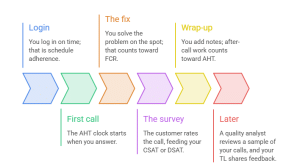
Here is an illustrative example of how these terms show up in one shift.
- Login. You log in on time. That is schedule adherence, and it supports the team’s SLA.
- First call. The AHT clock starts when you answer.
- The fix. You solve the problem on the spot. That counts toward FCR.
- The survey. The customer rates the call. That feeds your CSAT, or DSAT if it goes badly.
- Wrap-up. You add your notes. That is after-call work, and it counts toward AHT.
- Later. A quality analyst reviews a sample of your calls, and your TL shares feedback.
Want to see the human side? Read our day in the life of a customer support executive.
How these terms shape your day
At Maxicus, agents work toward monthly targets for quality, productivity and customer satisfaction. Your TL will explain the exact numbers for your process. They vary by client, so ask in training.
A few habits help in every process:
- Learn the SOP early, so you spend less time searching.
- Treat QA feedback as free coaching.
- Be quick and complete, not just quick.
- Say a clear, friendly closing line on every call.
- Ask your TL which numbers matter most for your process.
Interview-ready one-liners
Recruiters often ask these. Practice saying them in your own words. For more, see our 25 BPO interview questions and answers and our interview process guide.
- What is AHT? The average time to handle one customer contact, including talk time, hold time and after-call work.
- What is FCR? The percentage of issues resolved on the first contact, with no callback needed.
- What is CSAT? A score showing how satisfied customers are, usually from a short survey after the interaction.
- What does QA do? QA reviews calls and chats against a checklist and gives feedback to improve quality.
- What is an SLA? An agreement with the client on service quality and response time, such as answering a set share of calls within a set time.
Quick quiz
Try these, then check the answers.
- Which three parts make up AHT?
- 41 of 50 survey responses are satisfied. What is the CSAT?
- 55% promoters and 15% detractors gives what NPS?
- Which metric drops when customers have to call back?
- Who coaches you day to day?
Answers: 1) Talk time, hold time and after-call work. 2) 82%. 3) 40. 4) FCR. 5) Your Team Leader.
FAQs
Q: What is AHT in BPO?
AHT is Average Handle Time. It is the average time to fully handle one customer contact, including talk time, hold time and after-call work.
Q: What is the full form of SLA in BPO?
SLA stands for Service Level Agreement. It is the promise a BPO makes to its client about service speed and quality.
Q: What is the CSAT full form in BPO?
CSAT stands for Customer Satisfaction Score. It shows how satisfied customers are after an interaction.
Q: What is the full form of FCR in BPO?
FCR stands for First Call Resolution. It means the issue is solved on the first contact.
Q: What is the QA full form in BPO?
QA stands for Quality Assurance. In a BPO it refers to the team, and the quality analysts in it, who review calls and chats.
Q: What is the full form of TL in BPO?
TL stands for Team Leader. A TL coaches a team and owns its day-to-day performance.
Q: What is the NPS full form?
NPS stands for Net Promoter Score. It measures how likely customers are to recommend a company.
Q: What is a good AHT?
There is no single number. It depends on the process, the client and the type of query. Ask your TL for the target on your process.
Q: What is shrinkage in BPO?
Shrinkage is the share of paid time agents are not available to handle customers, because of breaks, training, meetings or leave.
Ready to learn these on the job?
Freshers are welcome at Maxicus. The minimum qualification for full-time Customer Support Executive roles is 12th pass, and we teach most job skills in training. See the eligibility guide, compare voice and non-voice roles, and polish your communication skills.
Apply now and start your BPO career.
Share: