+91 - 9877098771
 ‣Blogs
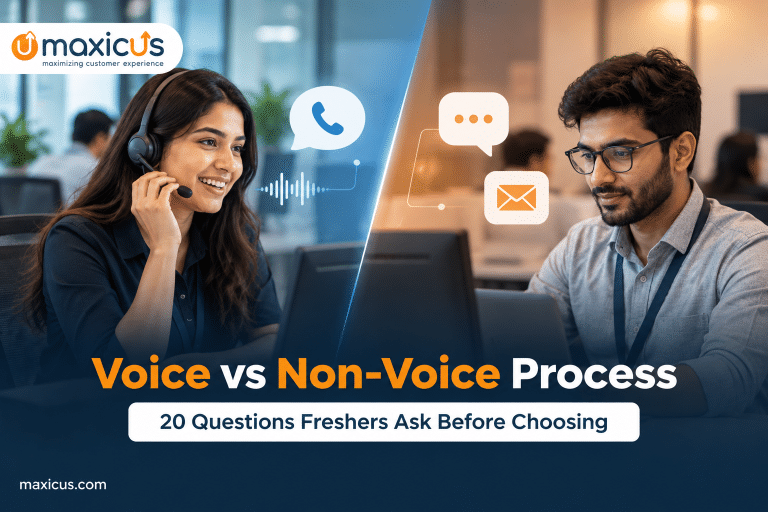
Voice vs Non-Voice Process: 20 Questions Freshers Ask Before Choosing
Voice or non-voice? It’s the first real choice most freshers face when applying for a customer support job, and most career pages skip it.
Here are 20 questions answered with what we publish on our own pages and with named outside sources. Where there’s no fixed answer, we say so.
Voice vs Non-Voice at a Glance
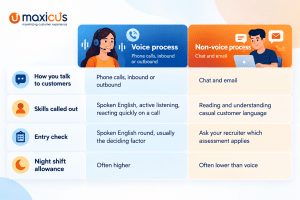
Sources: Indeed, our BPO interview guide, and our night shift guide.
The Basics
1. What is a voice process?
A role where you talk to customers by phone, either taking their calls or calling them, according to Indeed. At Maxicus, executives handle voice, chat, or email interactions, as we show in our day in the life of a Customer Support Executive.
2. What is a non-voice process?
A role where you help customers in writing instead of on a call. Indeed describes it as communicating through a computer chat function. In our customer service fit guide, chat and email support sit alongside voice support as separate role types.
3. What’s the difference between inbound and outbound?
- Inbound: the customer contacts you.
- Outbound: you contact the customer.
Our fit guide lists both inbound and outbound calls under voice support.
4. Does Maxicus offer both?
Our customer support jobs page lists phone, email, chat, and social media as the channels our teams use to answer queries and resolve issues.
5. Who decides which process I join?
Ask your recruiter which process your opening belongs to. Then say what you prefer. Our interview guide tells candidates to be upfront about role and shift preferences, and not to say they’re fine with anything.
Skills and Selection
6. Do I need fluent English for voice?
You need clear spoken English. Our guide says it directly affects how well you do the job, and that the communication round is usually the deciding factor. Pronunciation, pace, and clarity are what get tested. Indeed also lists excellent spoken language skills for voice roles.
7. What happens in the spoken English test?
Per our interview guide, most BPO companies, including Maxicus, use a structured test similar to Versant. It covers:
- Reading aloud
- Sentence repetition
- Spontaneous speech (1 to 2 minutes)
- Listening comprehension from audio clips
- Retelling stories
For reference, Pearson’s own test description for its Versant English Speaking and Listening test says about 37 items in about 20 minutes, taken on a phone app or computer with no human examiner. Ours is similar, not necessarily identical, so use those numbers as a guide to the format. For prep, see how to prepare your communication skills.
8. What does a non-voice process need from me?
Indeed says non-voice work needs a strong ability to read and understand more casual language. On chat or email, the customer’s message is all you have to go on, so reading it right matters.
9. Which languages can I apply in?
Our application form lists English, Hindi, and ten regional languages: Assamese, Gujarati, Kannada, Malayalam, Marathi, Oriya, Punjabi, Tamil, Telugu, and Bengali. Check the form for current options.
10. Do I need a degree or experience?
Most voice and customer support roles weigh communication skills, attitude, and willingness to learn over formal qualifications, and companies routinely hire freshers and undergraduates, as we explain in our BPO myths post. At Maxicus, 12th pass is the minimum. See the 12th pass guide.
11. Will I get training before I go live?
Yes. Our fit guide says Maxicus provides end-to-end training before you go live. Our day-in-the-life post adds that lunchtime training runs in short, game-like modules with points, badges, and leaderboards.
Day to Day
12. What does a typical day look like?
Our day-in-the-life article walks through one:
- 9:00 AM: login and morning briefing
- 10:00 AM: live customer interactions begin
- 1:00 PM: lunch and training
- 3:00 PM: quality checks
- 5:00 PM: team huddles
- 6:30 PM: wrap-up and handoff
13. Will I have to work night shifts?
It varies. Our myths post says many domestic voice and non-voice processes run day shifts, with flexible or rotational options increasingly offered. Our interview guide notes most voice-process roles require flexibility. Our night shift guide says rotational or hybrid options are common rather than fixed night-only schedules.
14. Does voice or non-voice pay more?
Our night shift guide says voice roles often carry a higher shift allowance than non-voice or back-office work. We don’t publish salary figures for either process, so ask your recruiter about the role you’re applying for.
15. How am I measured?
Quality, productivity, and customer satisfaction targets, set each month, per our day-in-the-life article. Quality checks are part of the daily schedule.
16. What do customers actually prefer, calls or chat?
A YouGov Profiles survey of US consumers (published March 2025) found:
- 35% prefer phone, the top choice
- 23% prefer email
- 10% prefer live chat
- 52% of Baby Boomers prefer phone, against 25% of Gen Z
- Nearly 70% use phone support, though only 35% prefer it
That’s US customer behavior, not a hiring forecast. It does show demand for both phone and written support.
Growth and Choosing
17. Can I grow from either path?
Our day-in-the-life post calls the path from executive to team lead or quality analyst real and common. Our pages describe one ladder and don’t split it by voice or non-voice. See the BPO career path from fresher to team leader.
18. Can I switch between voice and non-voice?
We don’t state a fixed switching rule on our pages, so ask your recruiter before you join.
19. Which should I choose as a fresher?
Match it to the skills Indeed lists:
- Lean voice if you’re comfortable on the phone, listen closely, think fast on a call, and are ready for the spoken English round.
- Lean non-voice if you read well, handle casual written language easily, and prefer chat or email.
If both appeal, tell your recruiter.
20. How do I apply?
- Start on our careers page or the customer support jobs form, which lists Aadhaar and PAN cards as mandatory.
- Walking in? Read what to expect at a walk-in interview.
- Want the full flow? See our interview process, step by step.
Ready to Pick Your Path?
Pick the process that fits how you communicate, and we’ll take it from there. Connect with us now.
Share: