+91 - 9877098771
 ‣Blogs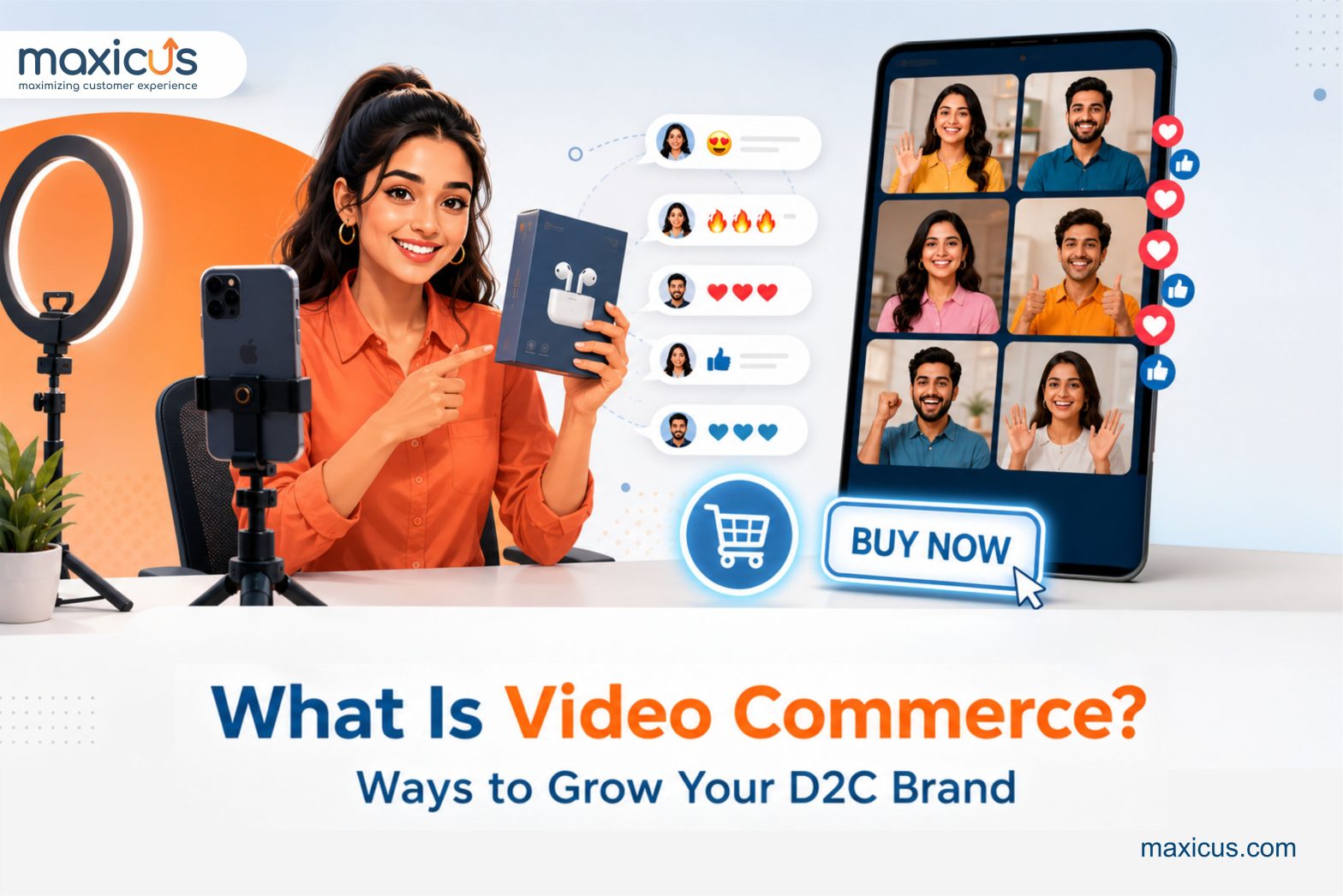
What Is Video Commerce? Grow Your D2C Brand
India’s D2C market crossed $87.5 billion in 2025 and is projected to hit $267 billion by 2030, growing at a CAGR of 25%, according to Mordor Intelligence. The country is now home to 800+ D2C brands, and the pace of growth shows no signs of slowing.
But growth alone does not guarantee wins. Indian D2C brands face a familiar problem: online shoppers browse, add to cart, and leave. Cart abandonment rates in the Asia-Pacific region hit 80.59%, the highest of any region globally. Static product pages and generic emails cannot close that gap.
Video commerce can.
In this blog, we break down what video commerce is, why it is built for D2C brands specifically, and the practical ways Indian brands are using it to drive conversions, reduce returns, and build customer loyalty at scale.
Table of Contents
- What Is Video Commerce?
- What Is a D2C Brand and Why Does This Matter?
- India’s D2C and Live Commerce Opportunity
- The Problem Video Commerce Solves
- Types of Video Commerce
- Key Benefits for D2C Brands
- Ways to Grow Your D2C Brand with Video Commerce
- Industries That Gain the Most
- How to Measure Success
- FAQs
What Is Video Commerce?
Video commerce is the use of live and pre-recorded video to sell products online, combining the engagement of video content with the immediacy of e-commerce. Shoppers watch live product demonstrations, ask questions in real time, and complete purchases within the same session, without ever leaving the experience.
Think of it as bringing the in-store shopping experience online, with the scale, reach, and data capabilities that digital gives you.
Video commerce operates across four primary formats:
- Live streaming with in-session purchasing – a host or agent demonstrates products live; viewers buy instantly
- One-to-one video consultations – a customer connects directly with a product specialist for a personalized buying session
- Shoppable videos – pre-recorded or short-form content with embedded product links that viewers tap to purchase
- One-to-many live broadcasts – brand-led live events reaching large audiences simultaneously
What Is a D2C Brand and Why Does This Matter?
A D2C brand (Direct-to-Consumer brand) sells its products directly to end customers, without relying on third-party retailers, marketplaces, or distributors. D2C ecommerce brands own the entire customer journey, from first touchpoint to post-purchase experience.
This model gives D2C brands significant advantages: full control over pricing, data, and customer relationships. But it creates a specific challenge. Without the footfall of a retail store or the trust signals of a marketplace, D2C brands must work harder to build the kind of buying confidence that converts browsers into buyers.
This is exactly where video commerce becomes a growth lever. When a D2C brand integrates live shopping or one-to-one video consultations into its customer journey, it recreates the human connection of in-store retail at scale, online, and with measurable outcomes.
The Problem Video Commerce Solves for D2C Ecommerce
Traditional e-commerce, even with great photography and detailed product pages, has structural limitations that no amount of copy optimization fully resolves:
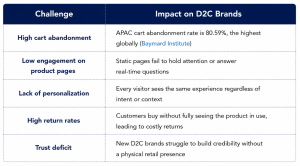
Video commerce directly addresses all five. Live demonstrations reduce uncertainty. Real-time Q&A removes hesitation. One-to-one sessions build the kind of trust that static pages cannot replicate.
Types of Video Commerce
One-to-One Live Video Shopping
A customer connects with a specialist for a private, real-time product consultation. Ideal for high-consideration purchases where personalization matters: electronics, home appliances, skincare, jewellery, fitness equipment.
Best for: Conversion, upselling, cross-selling, reducing returns.
One-to-Many Live Commerce
A single host streams to a large audience simultaneously, demonstrating products, answering questions, and driving in-session purchases. Ideal for product launches, festive campaigns, and brand awareness.
Best for: Reach, brand awareness, cost-effective engagement at scale.
Shoppable Video
Pre-recorded video content with embedded product links that allow viewers to purchase without leaving the video. Works well on social media, landing pages, and email campaigns.
Best for: Content marketing, social commerce, top-of-funnel capture.
Video-Assisted Support
Support interactions conducted via video, where agents resolve customer issues and simultaneously recommend complementary products. Transforms support from a cost centre into a revenue channel.
Best for: Retention, loyalty, average order value growth.
Key Benefits of Video Commerce for D2C Brands
- Higher Conversion Rates
Live shopping conversion rates consistently range between 9% and 30%, compared with typical e-commerce conversion rates of 2–3%. That represents a conversion rate up to 10 times higher than traditional product pages, according to GetStream’s livestream shopping analysis. In well-executed events, add-to-cart rates during live sessions reach as high as 34%. - Lower Cart Abandonment
When a customer can ask a question live and receive an immediate, visual answer, hesitation drops and purchase confidence rises. Brands using live commerce consistently report significant reductions in cart abandonment compared to standard product page traffic. - Fewer Returns
Live shoppers are approximately 40% less likely to return items than regular online shoppers. When customers see exactly how a product looks, fits, or functions before buying through a live demo or video consultation, post-purchase surprises disappear. - Stronger Customer Engagement
Video commerce sessions generate significantly higher engagement than standard product pages. Customers who participate in live shopping sessions spend more time with the brand and return more frequently, building loyalty that drives repeat purchases over the long term. - Higher Average Order Value
Live agents can demonstrate complementary products in context, making upselling and cross-selling feel natural rather than pushy. Companies that lean into live streaming early report top-line revenue growth of up to 25%. - Real-Time Data and Insights
Every video commerce session generates structured data: watch time, click-through rates, questions asked, products viewed, items purchased. This feeds directly into product development, content strategy, and customer segmentation, creating a feedback loop that improves every subsequent session.
Ways to Grow Your D2C Brand with Video Commerce
- Start with One-to-One Video Consultations
The highest-intent format to launch with. A live video specialist who can answer questions and demo the product in real time closes sales that a product page alone cannot. This is especially effective for appliances, skincare, fitness equipment, and home decor where product fit and customization matter. - Run Live Commerce Events Around Key Moments
Plan live shopping sessions around product launches and festive campaigns like Diwali, Republic Day, and IPL season. Offer session-exclusive deals to drive urgency. Live commerce events give audiences a reason to tune in regularly, not just when they need something. - Embed Shoppable Videos Across the Customer Journey
Do not limit video to product pages. Embed shoppable video in email campaigns, social ads, landing pages, and retargeting sequences. For D2C ecommerce brands, shoppable video works especially well in social commerce channels where buyers discover products passively. - Turn Support into a Sales Channel
Every support interaction is a revenue opportunity. When a video support session includes a live product walkthrough, customers are more likely to upgrade or add complementary products. This converts a cost centre into a measurable revenue channel without requiring separate sales headcount. - Use Session Data to Improve Continuously
Every live commerce session is also a research session. Track what triggers in-session purchases, where viewers drop off, and which agents convert best. Use this to sharpen product presentation and identify your highest-performing formats and time slots. - Build Trust Through Consistency
A D2C brand that runs regular live sessions and maintains a library of product demonstration videos signals to customers that it stands behind its products. This consistency drives repeat purchases and word-of-mouth referrals over time.
Industries That Gain the Most from Live Commerce in India
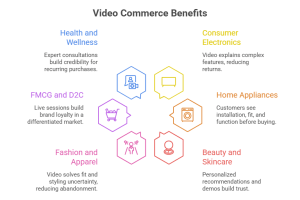
Fashion and apparel led India’s live commerce segment in 2024, while health and wellness is now the fastest-growing product segment in the forecast period. Here is how different sectors benefit:
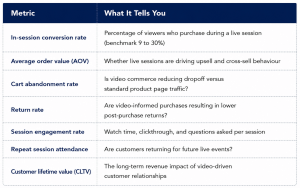
How to Measure Video Commerce Success
D2C brands should track these core metrics to evaluate and optimize their video commerce performance:
Conclusion
India’s D2C market is one of the fastest-growing in the world, but growth brings increasing competition for the same customer’s attention. D2C brands that rely solely on static product pages, standard email sequences, and marketplace listings are fighting on diminishing ground.
Video commerce changes the equation. With live shopping conversion rates reaching up to 30%, return rates dropping by up to 40%, and India’s live commerce market growing at 37% annually, the data is clear: interactive video is becoming the standard for how D2C brands build trust and close sales online.
Maxicus offers fully managed video commerce solutions for D2C brands, from agent-led one-to-one consultations and live shopping broadcasts to omnichannel video support, helping brands go live in days and drive measurable results from the first session.
Explore Maxicus Video Commerce | Talk to our team
Frequently Asked Questions (FAQs)
Q: What is video commerce in simple terms?
Video commerce is the use of live or pre-recorded video to sell products online. It lets customers watch demonstrations, ask questions, and make purchases in real time, replicating the in-store shopping experience digitally.
Q: What is a D2C brand?
A D2C (Direct-to-Consumer) brand sells directly to end customers without intermediaries like retailers or distributors. D2C ecommerce brands own the full customer relationship, which makes personalized experiences like video commerce especially valuable.
Q: How does video commerce increase conversions?
By replacing static product pages with live demonstrations and real-time interaction. Live shopping conversion rates range from 9-30%, compared with 2-3% for standard ecommerce, according to GetStream.
Q: Is video commerce only for large brands?
No. Video commerce is accessible to brands of any size. One-to-one formats are particularly cost-effective for smaller D2C brands because they require no broadcast infrastructure and can be started with minimal setup.
Q: What is the difference between live commerce and shoppable video?
Live commerce involves real-time streaming where viewers can purchase during the session. Shoppable video refers to pre-recorded content with embedded purchase links. Both are forms of video commerce and work best used together across different stages of the customer journey.
Q: How big is India’s live commerce market?
India’s live commerce market was valued at $996 million in 2024 and is projected to reach $6.38 billion by 2030, growing at a CAGR of 37.1%, according to Grand View Research.
Q: Which product categories benefit most from video commerce in India?
Fashion and apparel, consumer electronics, home appliances, beauty and skincare, health and wellness, and FMCG D2C brands in India consistently see the strongest results from live commerce and one-to-one video shopping sessions.
Share: