+91 - 9877098771
 ‣Blogs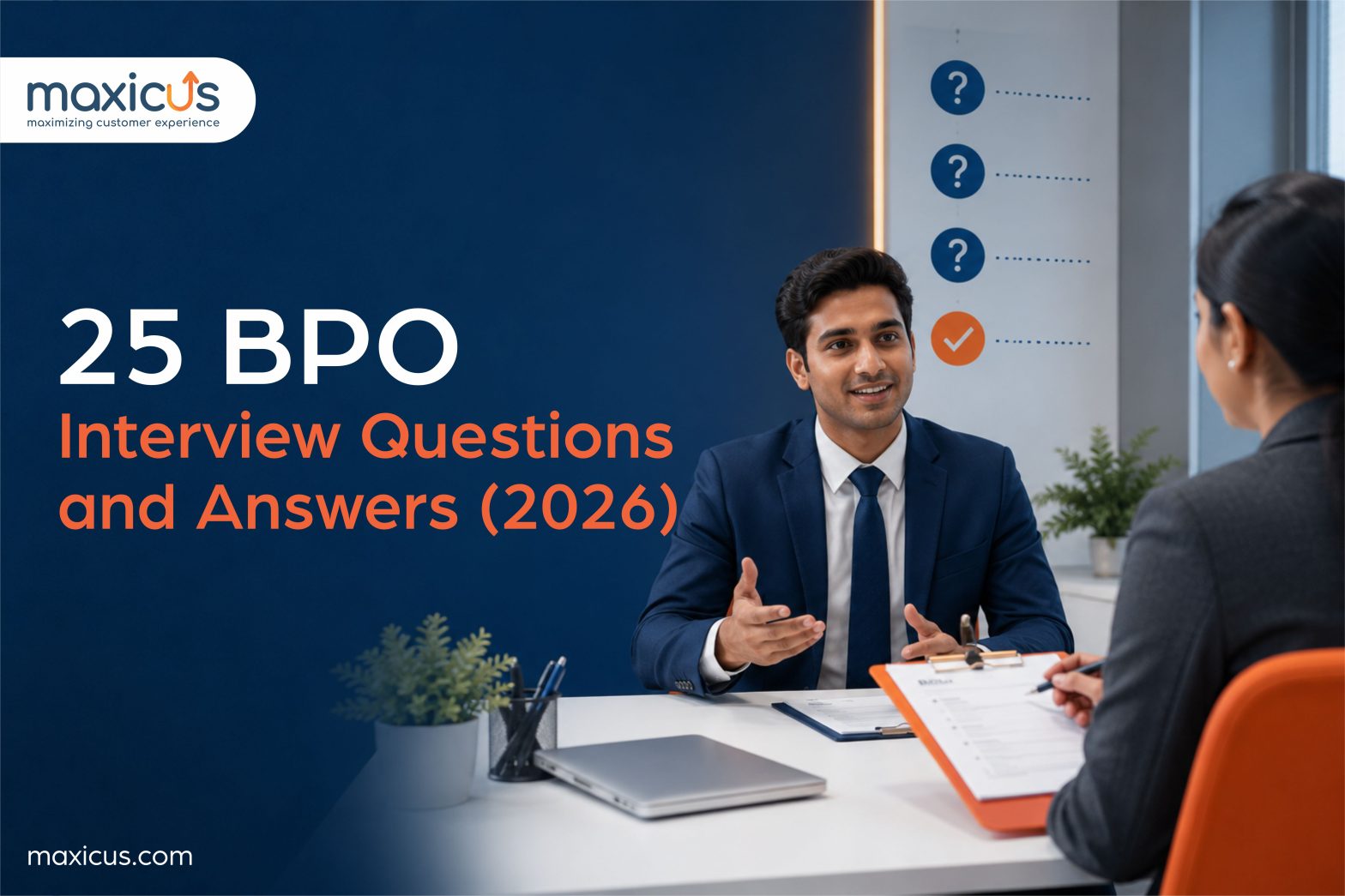
25 BPO Interview Questions and Answers That Recruiters Actually Ask
If you are about to sit for a BPO interview, you have probably already typed some version of this into Google. Every candidate does, whether they are applying in Gurgaon, Bangalore, Kolkata, Vadodara, or Amritsar. The reason is simple, BPO interviews follow a fairly predictable pattern across companies, and once you know what recruiters are actually listening for, your chances of clearing the interview go up.
This guide covers the 25 questions that come up most often across HR rounds, communication assessments, and situational or operations rounds, along with sample answers, what recruiters are really evaluating, and the dos and don’ts that most candidates get wrong.
How a Typical BPO Interview Is Structured
Most BPO interviews, including the process at Maxicus, follow four broad stages:
- HR Screening – a short call or in-person round to check your background, availability, and basic communication.
- Communication or Versant Test – an assessment of your spoken English, pronunciation, and listening comprehension.
- Situational or Operations Round – questions that test how you would handle real customer scenarios.
- Client Interview – for process-specific roles, a final round with the client’s team.
For the complete step-by-step breakdown of how this works at Maxicus, including what the Versant test involves, read our Maxicus Interview Process guide.
Section 1: HR Round Questions (Q1 to Q10)
The HR round checks whether you are a reliable, coachable, and communicative candidate before you move further. Keep answers honest, specific, and under two minutes each.
Q1: Tell me about yourself.
Keep this to your education, one or two relevant skills or experiences, and why you are interested in the role. Avoid reciting your full resume. Example: “I recently completed my graduation and have been working on my communication and problem-solving skills through part-time customer-facing roles. I am looking for a company where I can grow in a structured CX environment, and that is why I applied to Maxicus.”
Q2: Why do you want to work in the BPO industry?
Recruiters want to see that you understand what the job involves, not just that you need a job. Talk about stable income, skill development, and career growth into team lead or quality roles.
Q3: Why do you want to join our company specifically?
This checks if you researched the company. Mention something specific, such as the industries they serve, their AI-driven approach, or their reputation for training freshers.
Q4: What do you know about our company?
Have two or three facts ready. For Maxicus, you could mention that it is a CX and BPO company operating under the KocharTech group, working with brands across e-commerce, BFSI, and healthcare, with delivery centers across multiple Indian cities.
Q5: Are you comfortable working in rotational or night shifts?
Be honest here. Most voice-process roles require flexibility, and recruiters would rather know upfront than deal with attrition later.
Q6: What are your strengths and weaknesses?
Pick a strength relevant to CX work, such as patience or active listening. For weaknesses, choose something real but manageable, and mention what you are doing to improve it.
Q7: Where do you see yourself in five years?
Show ambition without sounding like you plan to leave immediately. Example: “I would like to grow from a customer support role into a team lead or quality analyst position within the company.”
Q8: Why should we hire you?
Summarize your relevant skills and attitude in two sentences. Confidence matters more than a perfect answer here.
Q9: Do you have any prior customer service or communication experience?
If you do not have formal experience, talk about situations where you handled people, complaints, or coordination, even in college or part-time settings.
Q10: What are your salary expectations?
For freshers, it is usually safe to say you are open to the standard package for the role and flexible based on company norms, unless you have specific research on the role’s pay band.
Section 2: Communication and Language Assessment (Q11 to Q15)
Most BPO companies, including Maxicus, use a structured spoken English test similar to Versant. You will not be asked to answer these in the traditional sense, but you need to know what to expect and how to prepare.
Q11: Read the given paragraph aloud.
Tests pronunciation, pace, and clarity. Practice reading English news articles aloud daily in the week before your interview.
Q12: Repeat the sentence you just heard.
Tests listening accuracy and short-term memory. Do not paraphrase, repeat exactly what you heard.
Q13: Speak for one to two minutes on a given topic.
Tests spontaneous speech and fluency. Common topics include your city, a hobby, or a recent event. Practice speaking without long pauses or filler words.
Q14: Answer a question based on a short audio clip.
Tests listening comprehension. Focus on the main idea rather than trying to catch every word.
Q15: Retell a short story in your own words.
Tests structure and vocabulary. Summarize the beginning, middle, and end clearly instead of repeating it word for word.
For a deeper breakdown of how to prepare for this stage, see our guide on preparing your communication skills for a customer care interview.
Section 3: Situational and Behavioral Questions (Q16 to Q25)
This round checks how you actually think under pressure. A useful framework here is the STAR method, where you describe the Situation, Task, Action, and Result. Keep answers specific and calm.
Q16: How would you handle an angry customer who is shouting at you?
Say that you would stay calm, let the customer express their frustration without interrupting, acknowledge the issue, and then move toward a solution rather than reacting emotionally.
Q17: A customer asks for a refund that goes against company policy. What do you do?
Explain that you would clearly and politely communicate the policy, offer any alternative solution available, and escalate to a supervisor if the customer is not satisfied.
Q18: Describe a time you had to deal with a difficult person. How did you handle it?
Use a real example, even from college or a part-time job. Focus on staying patient and finding a resolution.
Q19: If you do not know the answer to a customer’s question, what will you do?
Say you would be honest about needing to check, ask the customer to hold or offer a callback, and get the correct information rather than guessing.
Q20: How do you handle multiple customers or tasks at the same time?
Talk about prioritizing based on urgency and staying organized, rather than claiming you can do everything at once perfectly.
Q21: What would you do if a customer used abusive language?
State that you would remain professional, calmly ask the customer to communicate respectfully, and follow the company’s escalation process if needed rather than responding in kind.
Q22: How do you stay motivated doing repetitive work?
Recruiters ask this because attrition is high in repetitive voice roles. Talk about setting small daily goals or focusing on the impact of helping each customer.
Q23: Tell me about a time you made a mistake at work. How did you fix it?
Own the mistake honestly, explain what you did to correct it, and mention what you learned. Avoid blaming others.
Q24: If your team lead gives you feedback you disagree with, how do you respond?
Show that you can accept feedback professionally, ask clarifying questions if needed, and adjust rather than becoming defensive.
Q25: How would you explain a technical issue to a customer with no technical knowledge?
Give an example of breaking down a complex idea into simple, everyday language, avoiding jargon.
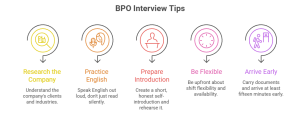
Dos and Don’ts for Your BPO Interview
Do:
- Research the company beforehand, including what industries or clients it serves.
- Practice speaking English out loud, not just reading silently.
- Prepare a short, honest self-introduction and rehearse it.
- Be upfront about shift flexibility and availability.
- Carry your documents and arrive at least fifteen minutes early.
Don’t:
- Don’t memorize answers word for word. It sounds robotic and recruiters notice.
- Don’t speak negatively about a previous employer or college.
- Don’t say you are fine with anything when asked about role or shift preferences. Be specific but flexible.
- Don’t panic if you make a grammar mistake during the communication round. Composure matters more than perfection.
- Don’t skip questions. If you don’t understand something, ask for clarification instead of guessing.
Frequently Asked Questions
Q: Is the BPO interview hard for freshers?
No. Most BPO interviews, including at Maxicus, are designed for freshers. The focus is on communication, attitude, and willingness to learn rather than technical experience.
Q: What is the most important round in a BPO interview?
The communication or Versant round is usually the deciding factor for voice-process roles, since clear spoken English directly affects your ability to do the job.
Q: How should I introduce myself in a BPO interview?
Keep it under a minute. Cover your education, one relevant skill, and why you are interested in the role. Avoid reading it off a memorized script.
Q: Do BPO companies ask technical questions?
For voice and customer support roles, questions are mostly situational and communication-based rather than technical. Technical or process-specific questions usually come up only in the client round for specialized processes.
Q: What should I wear to a BPO interview?
Business casual is the standard expectation. Dress neatly and avoid overly casual clothing like shorts or flip-flops, even for informal office cultures.
Ready to Put This Into Practice?
Maxicus is actively hiring for customer support and CX roles across Gurgaon, Bangalore, Vadodara, Kolkata, and Amritsar, for both freshers and experienced candidates. Explore open roles and apply today.
Share: