+91 - 9877098771
 ‣Blogs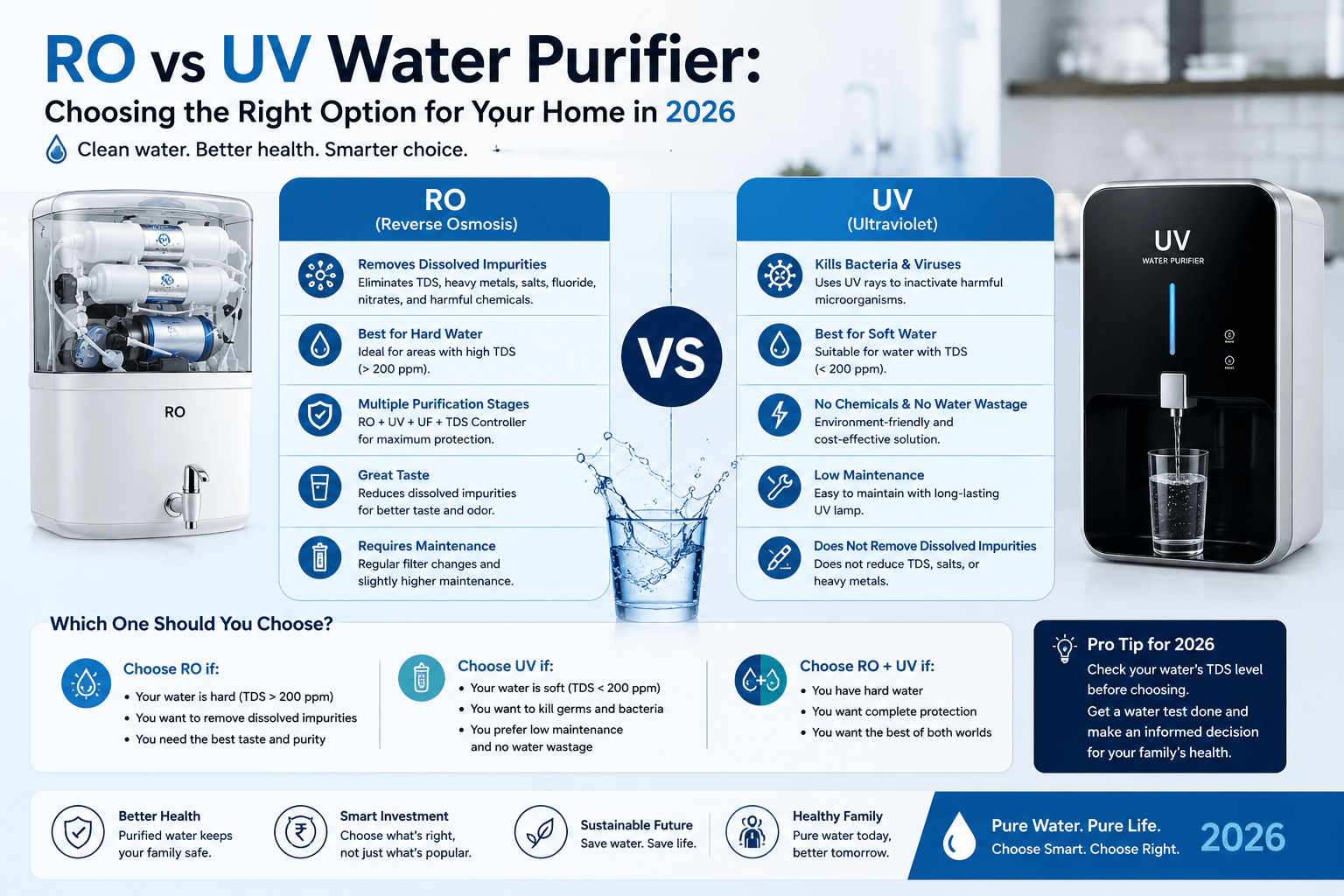
RO vs UV Water Purifier: Choosing the Right Option for Your Home in 2026
Access to clean drinking water is one of the most fundamental requirements for any household. As awareness about waterborne diseases grows, water purifiers have become essential home appliances across India. Among the most widely used technologies are Reverse Osmosis (RO) and Ultraviolet (UV) purification. This guide explains how each works, compares their strengths, and helps you make the right choice for your home.
Introduction
RO and UV purifiers have each earned their place in Indian homes, but they work differently and address different types of contamination. The right choice depends on your local water source, typical TDS (Total Dissolved Solids) levels, and your household’s specific needs.
- RO technology removes impurities by pushing water through a semi-permeable membrane, filtering out dissolved salts, heavy metals, bacteria, and other contaminants.
- UV technology uses ultraviolet light to kill bacteria, viruses, and other microorganisms without altering the chemical composition of the water.
- Both have clear strengths and limitations. This guide helps you choose wisely.
Table of Contents
- Understanding RO and UV Technologies
- Comparison: RO vs UV Water Purifiers
- Key Factors to Consider When Choosing
- Best Practices and Maintenance
- Frequently Asked Questions
- Conclusion
1. Understanding RO and UV Technologies
Reverse Osmosis (RO) Water Purifiers
How it works:
RO purifiers force water through a semi-permeable membrane under pressure, removing dissolved salts, heavy metals, bacteria, viruses, and chemical contaminants. The membrane filters particles as small as 0.0001 microns.
Benefits:
- Removes a wide range of impurities including dissolved solids, fluoride, arsenic, and lead.
- Improves taste and odour by removing chemicals that cause unpleasant flavour.
- Effective against biological contaminants as well as chemical ones.
Drawbacks:
- Also removes beneficial minerals, which reduces the natural mineral content of water.
- Higher upfront cost and ongoing maintenance due to membrane replacement every 1 to 2 years.
- Produces some wastewater during the filtration process.
Ultraviolet (UV) Water Purifiers
How it works:
UV purifiers pass water past an ultraviolet lamp that emits UV-C light, which destroys the DNA of bacteria, viruses, and microorganisms, rendering them unable to reproduce or cause infection.
Benefits:
- Does not remove beneficial minerals, preserving the natural taste of water.
- Lower installation and maintenance costs compared to RO.
- No water wastage during the purification process.
Drawbacks:
- Does not remove dissolved chemicals, heavy metals, or dissolved solids.
- Requires pre-treatment with a sediment filter to work effectively if the water has visible particles.
2. Comparison: RO vs UV Water Purifiers
| Factor | RO Purifier | UV Purifier |
| Best for | High TDS or chemical contamination | Low TDS, microbial contamination |
| Removes chemicals | Yes | No |
| Kills bacteria/viruses | Yes | Yes |
| Preserves minerals | No (removes most minerals) | Yes |
| Water wastage | Yes | No |
| Electricity use | Moderate | Low |
| Maintenance cost | Higher (membrane every 1-2 years) | Lower (UV bulb annually) |
| Initial cost | Higher | Lower |
3. Key Factors to Consider When Choosing
Water source and TDS levels:
If your tap water has high TDS or contains dissolved chemicals, heavy metals, or fluoride, RO is the better choice. If your source water is generally clean but may contain bacteria or viruses, UV is sufficient and more economical.
Budget:
UV purifiers are generally cheaper to buy and maintain. RO systems have higher upfront costs and require membrane replacement every 1 to 2 years.
Space and installation:
Both types can be wall-mounted or countertop units. Consider the available space in your kitchen and whether you prefer an under-sink or above-sink setup.
Maintenance commitment:
RO requires regular membrane checks and replacement. UV systems require annual UV bulb replacement and basic cleaning. Factor in the ongoing effort when making your decision.
4. Best Practices and Maintenance
RO Maintenance
- Check TDS levels regularly using a TDS meter to verify the membrane is performing correctly.
- Replace the RO membrane every 1 to 2 years, or as recommended by the manufacturer.
- Replace pre-filters every 6 to 12 months to prevent sediment from reducing membrane life.
UV Maintenance
- Replace the UV lamp every 12 months to ensure effective disinfection.
- Use a pre-sediment filter to remove particles before water reaches the UV chamber.
- Clean the quartz sleeve around the UV lamp periodically to maintain light transmission efficiency.
Frequently Asked Questions
Q: Can UV purifiers treat chemically contaminated water?
No. UV purifiers are specifically effective against microbial contamination (bacteria, viruses, and other microorganisms). They do not remove dissolved chemicals, heavy metals, or fluoride. For chemically contaminated water, RO is the appropriate choice.
Q: Which is better for Indian households with high TDS groundwater?
RO is generally the better option for areas in India where groundwater has high TDS levels or significant mineral content. A TDS meter reading above 300 mg/L typically indicates RO is needed.
Q: Do both RO and UV purifiers require electricity?
Yes. Both technologies require electricity to operate. RO uses a pump to pressurise water through the membrane; UV uses electricity to power the ultraviolet lamp.
Q: Is RO water safe for daily drinking if it removes minerals?
Yes. RO water is safe for daily consumption. While it removes some naturally occurring minerals, a varied diet provides the minerals your body needs. Some RO systems include a mineraliser stage that re-adds key minerals after filtration.
Q: Can UV purifiers work in commercial or industrial settings?
Yes. UV purification is effective in all settings, including commercial and industrial applications. However, for water with high chemical or TDS contamination, pre-treatment or RO is required alongside UV.
Conclusion
Choosing between RO and UV water purifiers comes down to understanding your local water quality. RO is the stronger choice for areas with hard water, high TDS, or chemical contamination. UV is the more economical and eco-friendly option for homes with reasonably clean source water that may have microbial risks.
By understanding these differences and testing your water quality before purchase, you can make a decision that genuinely improves your household’s access to clean, safe drinking water in 2026.
Ready to choose the right purifier? Contact our experts for personalised advice and a product demonstration through a live video session.
Share: