+91 - 9877098771
 ‣Blogs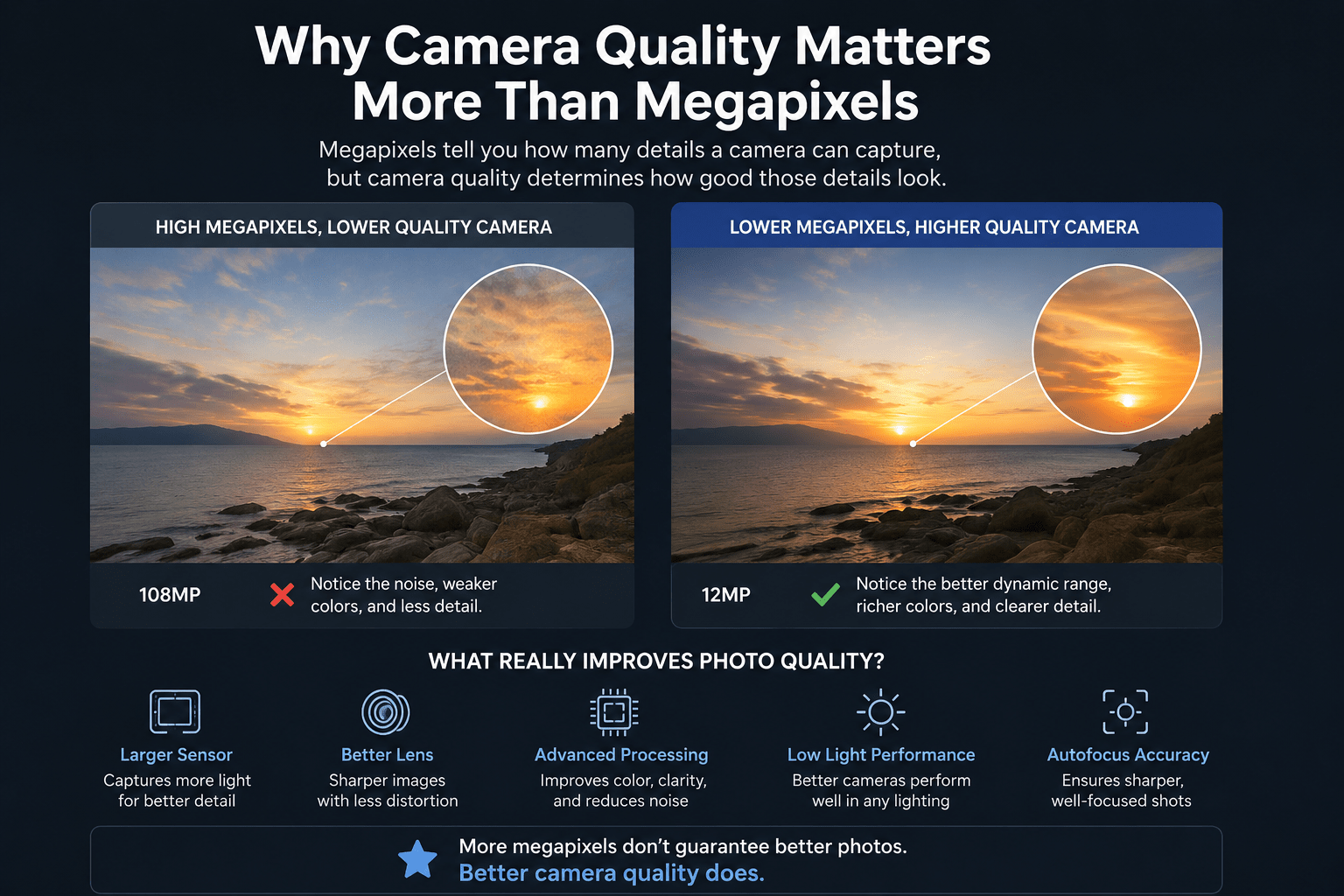
Why Camera Quality Matters More Than Megapixels
In digital photography, the megapixel count has long been used as the headline specification for cameras and smartphones. A higher number suggests more detail and higher resolution, making it a simple and convincing marketing figure. But this is a misleading way to judge camera quality. A 12-megapixel camera with a large sensor and excellent glass will consistently outperform a 200-megapixel camera with a tiny sensor and poor optics.
This blog explains why camera quality is a far more meaningful measure than megapixel count, and what actually determines whether a camera produces outstanding images.
Table of Contents
- The Myth of Megapixels
- What Actually Determines Camera Quality
- Image Processing and Software
- Real-World Applications
- Additional Features That Matter
- Frequently Asked Questions
- Conclusion
1. The Myth of Megapixels
Megapixels measure the total number of pixels in an image, which determines the maximum size at which it can be printed or cropped without visible degradation. Beyond a certain point, additional megapixels add file size without adding visible quality in most use cases.
A high megapixel count on a small, inexpensive sensor often produces images that are technically large but visually noisy, especially in low-light conditions. The individual pixels on a small sensor are packed more tightly, which means each captures less light and produces more image noise. A lower megapixel camera with a larger sensor and better optics will produce cleaner, sharper images in a wider range of conditions.
2. What Actually Determines Camera Quality
Sensor Size
Sensor size is arguably the single most important factor in image quality. A larger sensor has a greater surface area to capture light, which results in better performance in low-light conditions, a wider dynamic range, and less image noise. A 12MP full-frame sensor, for example, will generally outperform a 108MP smartphone sensor because its individual pixels are physically much larger, capturing more light per pixel with significantly less noise.
Lens Quality
The lens determines how accurately and sharply light is focused onto the sensor. A high-quality lens with superior optical construction reduces chromatic aberration, distortion, and softness at the edges of the frame. Even with a 100MP sensor, a low-quality or plastic lens will produce images that look soft and lack fine detail. Professional photographers invest heavily in quality glass for exactly this reason.
Dynamic Range
Dynamic range refers to the camera’s ability to simultaneously capture detail in both very dark and very bright areas of the same scene. A camera with a wide dynamic range can preserve the texture of shadows while keeping highlights from blowing out, which is critical for high-contrast scenes like bright exteriors or sunlit portraits.
3. Image Processing and Software
Modern cameras, particularly smartphones, rely heavily on computational photography to produce their final images. The image signal processor (ISP) and the software pipeline determine how raw sensor data is converted into a finished photograph.
Superior software makes a measurable difference. A 12MP iPhone photo can look better than a 200MP budget phone photo because the iPhone’s image processing applies more sophisticated noise reduction, colour science, and detail enhancement algorithms. Companies like Apple, Google, and Sony invest heavily in this processing capability as a core competitive advantage.
“Sensor size, lens quality, and image processing software together determine the result you actually see. Megapixels tell you how big the file is; these three factors tell you how good it looks.”
4. Real-World Applications
Professional photographers and videographers consistently prioritise camera systems that balance sensor size, lens quality, and image processing over raw megapixel count. These systems excel across the full range of shooting conditions, from low-light indoor environments to high-contrast outdoor scenes.
In consumer smartphones, the gap between budget and premium cameras is not primarily about megapixel count. It is about sensor size, lens quality, and the sophistication of the image processing pipeline. The phones that consistently win in real-world camera comparisons are those that invest in all three.
5. Additional Features That Matter
- Autofocus system: Phase-detection autofocus and subject tracking ensure sharp images even in fast-moving scenarios, which matters for everyday photography as much as for professional work.
- Optical Image Stabilisation (OIS): Reduces blur caused by camera shake during handheld shooting, which is particularly valuable in low-light conditions where the shutter stays open longer.
- Aperture: A wider aperture (lower f-number) allows the lens to admit more light, improving low-light performance and enabling a shallower depth of field for portrait shots.
Frequently Asked Questions
Q: How many megapixels do I actually need for everyday use?
For most everyday use including social media sharing, printing up to A3 size, and standard digital viewing, 12MP to 24MP is more than sufficient. Beyond this range, you are primarily gaining the ability to crop heavily or print at very large sizes.
Q: Is a larger sensor always better?
Generally yes, in terms of light capture and low-light performance. However, a larger sensor requires a larger lens and a larger camera body, which is why compact smartphones use small sensors despite their high megapixel counts.
Q: Why do some 12MP cameras produce better photos than 108MP smartphones?
Because sensor size, lens quality, and image processing matter far more than pixel count. A 12MP camera with a large sensor, sharp lens, and sophisticated processing captures and presents light more accurately than a 108MP camera cramped onto a tiny sensor.
Q: Does video quality benefit from these same factors?
Yes. Video quality depends on the same fundamentals: sensor size, lens quality, dynamic range, and processing capability. These factors determine colour accuracy, sharpness, low-light performance, and stabilisation in video just as they do in still images.
Conclusion
Understanding what actually makes a camera good gives you a genuine advantage when choosing a smartphone or camera. Megapixel count is a single data point that tells you very little on its own. Sensor size, lens quality, and image processing together determine the images you actually see.
Whether you are buying a smartphone primarily for photography or evaluating a dedicated camera, focus on these fundamentals. The results in your photos will speak for themselves.
Want to see how different camera systems compare in real conditions? Book a live session with our experts and see the difference firsthand.
Share: