+91 - 9877098771
 ‣Blogs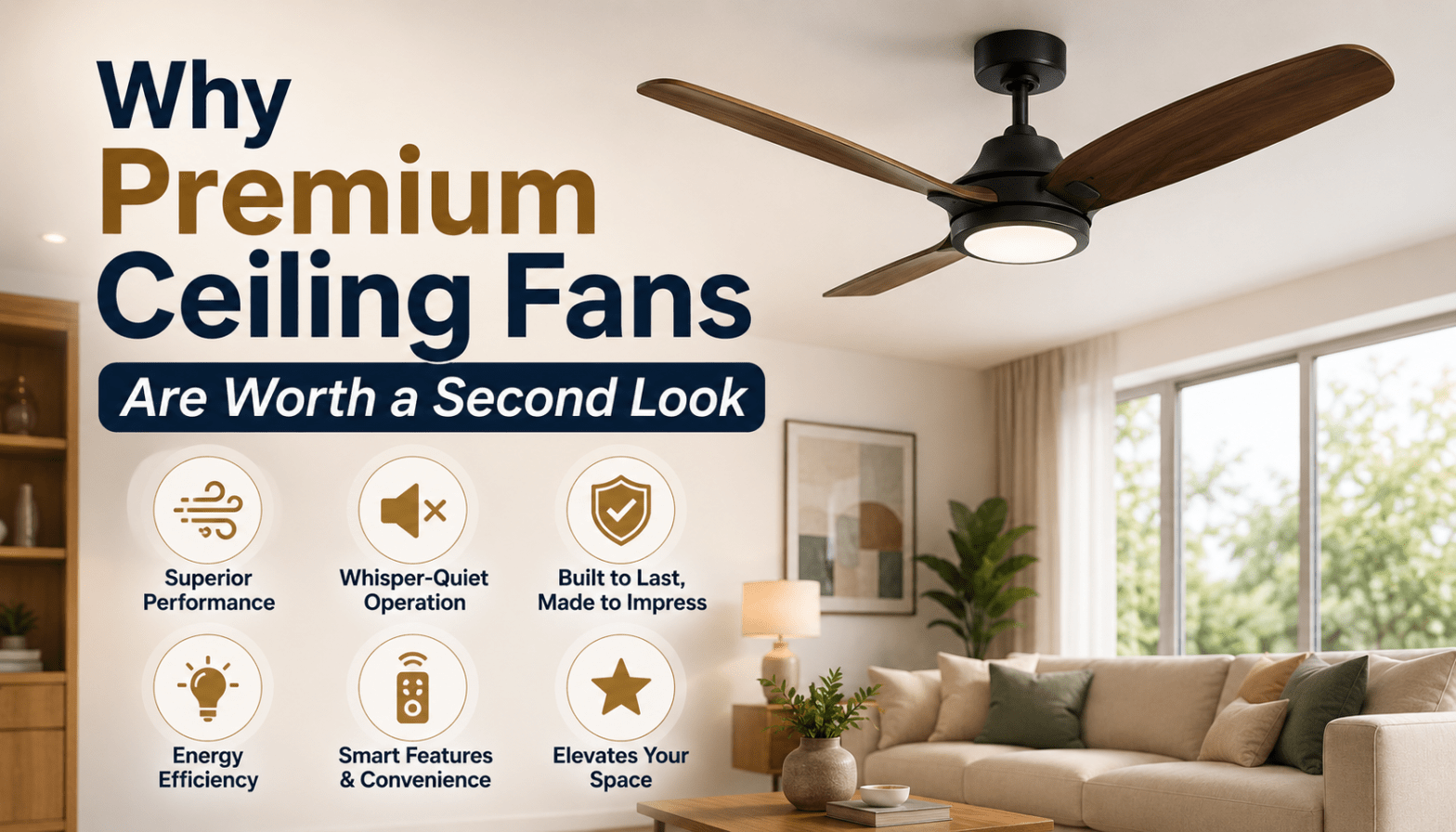
Why Premium Ceiling Fans Are Worth a Second Look
For decades, ceiling fans were treated as functional afterthoughts in Indian home design. They were expected to push air around and stay out of the way. Aesthetics, sound, and energy consumption were secondary concerns at best.
The home appliance landscape has changed dramatically. The modern premium ceiling fan is no longer just a fan. It is a DC motor-powered, whisper-quiet, smart home-connected climate management device that can look as good as any designer fixture. If you wrote off premium fans as an expensive luxury, here is why they deserve a second look.
Table of Contents
- Form Meets Function: The Design Difference
- The DC Motor Revolution
- Precision Engineering and Airflow Quality
- Smart Home Integration and Climate Control
- Superior LED Lighting
- The True Total Cost of Ownership
- Why Premium Fans Make Particular Sense in India
- Frequently Asked Questions
- Conclusion
1. Form Meets Function: The Design Difference
The most immediate difference between a standard retail fan and a premium model is its physical design. Standard fans typically offer limited colour options and generic blade shapes produced from basic moulded plastic.
High-end materials
Premium manufacturers use aircraft-grade aluminium, automotive-grade composite materials, and sustainably sourced hardwoods for their blade sets. These materials are lighter, stronger, and more dimensionally stable than standard plastics, which means they maintain their shape and balance far longer under the thermal stress of continuous daily operation.
Cohesive design language
A premium fan anchors the room rather than hiding in the ceiling. Whether your home aesthetic is minimalist industrial, warm traditional, or contemporary Scandinavian, premium brands offer models that complement specific interior styles rather than contrasting with them.
2. The DC Motor Revolution
The true heart of any ceiling fan is its motor. While conventional fans rely on older AC (Alternating Current) induction motors, premium fans increasingly use DC (Direct Current) motors, and the difference is significant.
Near-silent operation
AC motors produce an audible electrical hum that gets amplified by the ceiling structure, especially at low speeds in quiet rooms. DC motors run silently. If you have ever been kept awake by a ceiling fan’s low-frequency buzz, switching to a DC motor eliminates the problem entirely.
Massive energy savings
DC motors are dramatically more efficient than AC equivalents. A typical premium DC fan uses 25 to 35 watts at full speed, compared to 60 to 80 watts for a standard AC fan of similar size. Over the course of an Indian summer where fans run 12 to 16 hours a day, the electricity savings across a single fan are meaningful. Multiply that across every room in a home, and the annual saving is substantial.
More speed settings
Standard fans typically offer three fixed speed settings. DC motor fans typically offer six to eight or more incremental settings, allowing precise airflow control. You can find the exact speed that is comfortable without that frustrating gap between too slow and too fast.
3. Precision Engineering and Airflow Quality
Every fan wobbles slightly when cheap blade sets are used, or when the motor spindle is not perfectly balanced. This wobble wastes energy as lateral vibration rather than directed airflow, and it causes an annoying wobble noise that worsens over time.
Premium ceiling fans undergo rigorous factory balancing. Each blade set is weighed and matched precisely to its motor’s specifications. The result is a fan that produces a smooth, continuous column of downward airflow rather than choppy, turbulent air movement. This direct, laminar airflow is more effective at cooling occupants at lower fan speeds, which further reduces energy consumption.
4. Smart Home Integration and Climate Control
A premium price reflects a smarter appliance. High-end fans today function as intelligent climate control nodes in a connected home.
- Ecosystem compatibility: Premium fans connect to Wi-Fi and integrate with Apple HomeKit, Amazon Alexa, and Google Home. You can control speed, direction, and lighting with voice commands or through a single smart home app.
- Automated scheduling: Program your fan to gradually increase speed in the morning, shut off when you leave for work, and start again before you return home.
- Environmental sensors: Many top-tier models feature built-in temperature and humidity sensors. If a room exceeds a set temperature, the fan automatically increases speed without any manual input.
- Winter destratification: By reversing the fan direction at low speed, warm air collected near the ceiling is pushed outward and downward along the walls, which reduces heating costs in winter. Premium fans make this directional reversal instant and easy through the app or remote.
5. Superior LED Lighting
Many standard fans include rigid, low-quality light kits as an afterthought. The result is harsh, flickering, or yellowed light that degrades rapidly over months of use.
High-end fans feature integrated LED arrays with high CRI (Colour Rendering Index) ratings, typically 90 or above. This means the light they produce renders colours accurately and naturally, which matters significantly for reading, cooking, and general living comfort. They are also fully dimmable, allowing you to adjust from full brightness for tasks down to a warm ambient glow for evenings, all through the same remote or app.
6. The True Total Cost of Ownership
Sticker shock is the most common reason people avoid premium fans. A quality premium DC motor fan may cost three to five times more than a basic AC fan. However, looking only at the purchase price ignores the complete financial picture:
- Energy savings: At 12 to 16 hours daily use over an Indian summer, the energy cost difference between a 75-watt AC fan and a 28-watt DC fan is approximately Rs 400 to Rs 600 per fan per year at current electricity rates, depending on your tariff. Over five years, the energy savings alone can exceed the price difference.
- Replacement cycle: Premium fans with quality motors and materials routinely last 15 to 20 years with minimal maintenance. Standard fans often require replacement after 5 to 8 years. The total cost per year of ownership often favours the premium option when calculated correctly.
- Noise and comfort: There is also a quality-of-life calculation. A silent, precisely controlled, aesthetically pleasing fan in a bedroom or living room contributes to measurably better sleep and daily comfort.
7. Why Premium Fans Make Particular Sense in India
India’s climate and electricity infrastructure create specific conditions where the advantages of premium fans are amplified:
- Long summer seasons: In most of India, ceiling fans run for 8 to 10 months of the year. The energy savings and comfort benefits of a DC motor fan compound significantly with heavy, year-round use.
- Voltage fluctuations: Premium fans typically include built-in voltage stabilisation and surge protection that standard fans lack. This protects the motor from the voltage fluctuations common in many Indian cities and towns.
- Humidity tolerance: Coastal and tropical regions require fans that can handle high humidity without accelerating motor corrosion. Premium builds use better sealing and more corrosion-resistant materials than budget alternatives.
- Load-shedding resilience: Premium fans with DC motors operate effectively across a wider voltage range, meaning they continue to function at lower voltages when power supply quality drops, rather than stalling or humming.
Frequently Asked Questions
Q: Are premium ceiling fans available across India?
Yes. Brands like Orient Electric, Atomberg, Havells, Crompton, and Usha all offer premium DC motor ceiling fan ranges available across major e-commerce platforms and authorised dealers in most cities.
Q: How difficult is it to install a premium ceiling fan?
Installation is similar to any standard ceiling fan. If you already have a ceiling fan mount, most premium models can be fitted by an electrician in under an hour. Smart-enabled models require an additional step of connecting to your Wi-Fi network through the companion app.
Q: Do premium fans work with standard regulators?
Standard electrical regulators are designed for AC motors and are not compatible with DC motor fans. Premium DC fans come with their own dedicated remote controls or smart controls that replace the need for a wall regulator entirely.
Q: Is the noise reduction noticeable in everyday use?
Yes, and markedly so in bedrooms. DC motor fans operate at a noise level comparable to a library environment at most speeds. For anyone who has been disturbed by the hum or wobble of a standard fan during sleep or focused work, the difference is immediate.
Q: What is the warranty period for premium ceiling fans?
Most premium ceiling fan brands offer 2 to 5 years of warranty on the motor and a separate warranty period on other components. Some brands offer extended warranty options. Confirm the specific terms at the point of purchase.
Conclusion
Premium ceiling fans are not a luxury for the few. They are a well-engineered, practically superior alternative to the standard fans that fill most Indian homes, and the financial and comfort arguments for upgrading are genuinely compelling.
Choosing a premium ceiling fan means choosing silence, lower electricity bills, better airflow control, and an appliance that will still be performing well a decade from now. We spend the vast majority of our time indoors. The quality of that environment matters.
Want to see how a premium DC motor fan performs in real life? Book a free live demonstration with one of our product experts and experience the difference before you decide.
Share: