+91 - 9877098771
 ‣Blogs
What Is Agentic AI and Why Businesses Are Rapidly Adopting It
Enterprises today are under relentless pressure to do more with less. Customers expect instant, personalized, and consistent experiences across channels. Operations leaders are asked to scale without increasing costs. Digital transformation teams are expected to deliver continuous innovation—while managing growing complexity across systems, data, and geographies.
While automation and AI have helped address parts of this challenge, many organizations are reaching diminishing returns. Rule-based workflows struggle with exceptions. Bots need constant supervision. Insights arrive, but decisions still depend heavily on human intervention.
This is where Agentic AI is emerging as a game-changer. It represents a fundamental shift in how work is executed—moving from task automation to autonomous, goal-driven systems that can think, decide, and act at scale.
What Is Agentic AI?
Agentic AI refers to AI systems designed to operate as independent agents rather than passive tools. These agents are capable of understanding objectives, planning actions, executing tasks across systems, and adapting based on outcomes—all with minimal human intervention.
In practical terms, Agentic AI doesn’t wait for instructions at every step. Instead, it is given a goal—such as resolving a customer issue, optimizing a process, or maintaining service levels—and the autonomy to determine how that goal should be achieved within defined boundaries.
This makes Agentic AI especially relevant for complex enterprise environments, where variability, scale, and speed make manual coordination inefficient.
How Agentic AI Is Different from Traditional Automation and Generative AI
To understand why enterprises are accelerating adoption, it’s important to distinguish Agentic AI from earlier AI approaches.
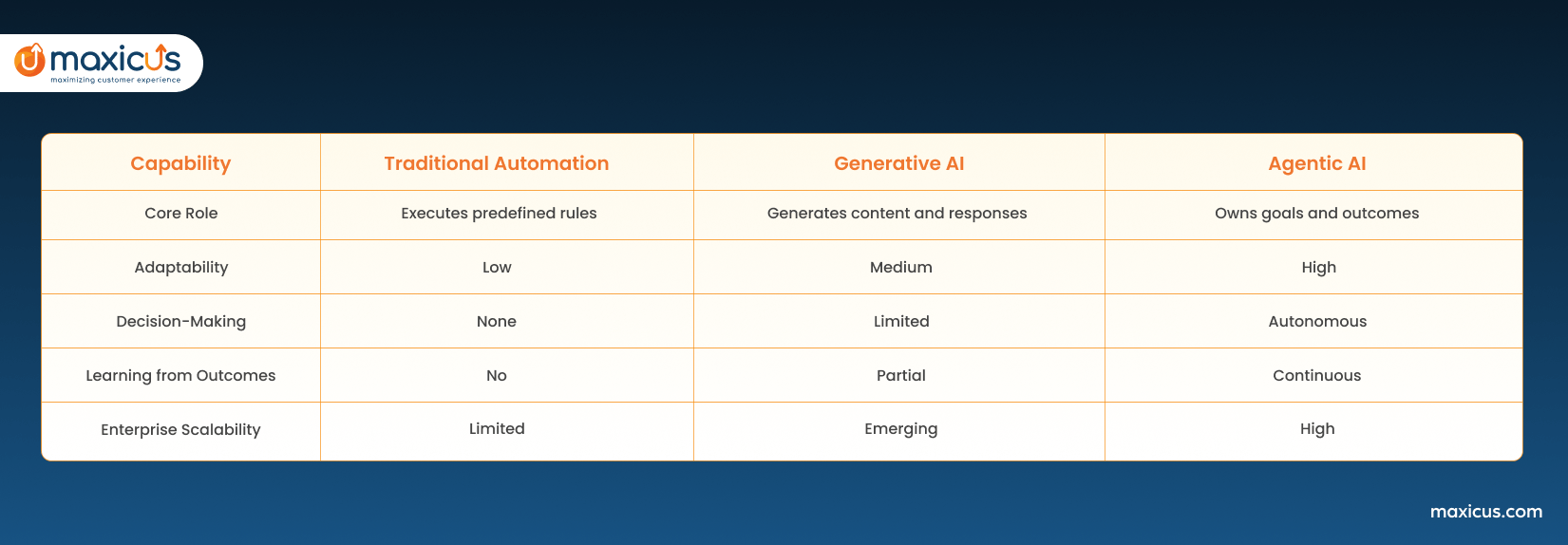
Traditional automation is efficient but brittle. Generative AI is powerful but reactive—it responds to prompts rather than driving workflows. Agentic AI brings these capabilities together and adds reasoning, orchestration, and autonomy, allowing systems to manage entire processes end to end.
Why Enterprises Are Adopting Agentic AI Now
The timing of Agentic AI adoption is not accidental. Enterprises are facing a convergence of business and technology pressures that make autonomy not just attractive, but necessary.
Customer expectations have evolved rapidly. People now expect issues to be resolved proactively, not just responded to. At the same time, global operations have become more complex, spanning multiple platforms, vendors, and regions. Manual oversight simply doesn’t scale in this environment.
Technology has also reached an inflection point. Advances in large language models, process orchestration platforms, real-time analytics, and cloud-native architectures have made it feasible to deploy autonomous systems safely and effectively.
Finally, decision velocity has become a competitive differentiator. Enterprises need systems that don’t just analyze data—but act on it in real time. Agentic AI fills this gap by enabling continuous, intelligent execution aligned with business objectives.
Real-World Business Impact Across CX, BPO, and Operations
Agentic AI delivers the most value in areas where complexity, volume, and variability intersect—precisely the domains where Maxicus supports global enterprises.
- Customer Experience Transformation
In customer experience, Agentic AI goes beyond chatbots or scripted workflows. It manages entire journeys.
For example, when a customer reports a service issue, an agentic system can identify the root cause, assess customer value and SLAs, coordinate across billing and logistics systems, trigger corrective actions, and communicate proactively—without waiting for human escalation. The result is faster resolution, lower operational cost, and a more seamless experience.
- Intelligent BPO and Service Operations
In BPO environments, Agentic AI acts as an orchestration layer across people, processes, and platforms. Instead of supervisors manually monitoring queues and performance, AI agents continuously prioritize work, route cases based on complexity, flag risks before SLAs are breached, and recommend interventions.
This enables service delivery models that are proactive rather than reactive—improving productivity, quality, and compliance simultaneously.
- Autonomous Process Management
Agentic AI is particularly powerful for managing end-to-end processes such as order-to-cash, claims processing, or workforce scheduling. Rather than automating individual steps, agents manage the full lifecycle, adapting to exceptions and learning from outcomes over time.
- Decision-Making at Scale
By combining analytics, historical performance data, and real-time signals, Agentic AI can make or recommend decisions at a speed and scale humans cannot match—while still operating within governance frameworks. This is critical for global enterprises balancing cost, risk, and customer impact.
How Organizations Can Prepare for Agentic AI Adoption
Adopting Agentic AI is as much an operational transformation as a technology one. Enterprises should start by clearly defining the outcomes they want AI agents to own—such as resolution time, service quality, or cost efficiency—rather than focusing solely on tools.
Strong data foundations and system integration are essential, as agents need access to real-time, reliable information. Processes must also be redesigned to allow autonomy, with humans focusing on strategy, oversight, and exception handling rather than routine execution.
Governance, trust, and explainability are critical. Clear guardrails ensure that autonomy enhances control rather than diminishing it.
Most importantly, enterprises benefit from working with partners who understand how to operationalize AI across CX, automation, analytics, and global delivery—turning experimentation into sustained impact.
Turning Agentic AI Into Enterprise Outcomes
Agentic AI marks the next phase of enterprise transformation—where intelligent systems don’t just assist teams, but actively drive outcomes across customer experience, operations, and decision-making.
For organizations that have already invested in automation and generative AI, Agentic AI becomes the missing layer that connects insights to action at scale.
At Maxicus, the focus has consistently been on making intelligence operational—combining CX transformation, AI-driven operations, automation, analytics, and scalable global delivery. As enterprises move toward Agentic AI, this integrated approach helps ensure that autonomy translates into measurable business value, not complexity.
The future of work is not about replacing people. It’s about enabling intelligent autonomy, where humans set direction and AI agents execute with speed, precision, and accountability.
Deliver CX & Operational Impact with Agentic AI
Frequently Asked Questions (FAQs) on Agentic AI
- What is Agentic AI in simple terms?
Agentic AI refers to AI systems that can operate autonomously toward a defined goal. Unlike traditional automation or generative AI, Agentic AI systems can plan actions, make decisions, execute tasks across enterprise systems, and learn from outcomes. In enterprise environments, this means AI that doesn’t just assist teams—but actively manages workflows and drives business outcomes.
- How is Agentic AI different from generative AI tools like chatbots?
Generative AI focuses on producing content or responses based on prompts, such as answering customer queries or summarizing information. Agentic AI goes further by owning the entire workflow. It can decide what actions to take, trigger backend processes, coordinate across systems, and continuously optimize outcomes—making it far more suitable for large-scale CX, BPO, and operations use cases.
- Why is Agentic AI important for customer experience transformation?
Agentic AI enables end-to-end customer journey management rather than isolated interactions. It allows enterprises to proactively resolve issues, personalize experiences at scale, and reduce resolution times—while lowering cost-to-serve. For organizations focused on CX transformation, Agentic AI helps move from reactive support to predictive and proactive engagement.
- How does Agentic AI improve BPO and service operations?
In BPO and managed services environments, Agentic AI acts as an intelligent orchestration layer across people, processes, and platforms. It can dynamically prioritize work, route cases based on complexity, predict SLA risks, and recommend corrective actions—enabling proactive, outcome-driven service delivery and higher operational efficiency.
- Is Agentic AI a replacement for human teams?
No. Agentic AI is designed to augment human teams, not replace them. It takes ownership of repetitive coordination, decision logic, and execution at scale—freeing human employees to focus on strategy, empathy, innovation, and exception handling. The most effective models combine intelligent AI agents with human oversight.
- What enterprise processes are best suited for Agentic AI?
Agentic AI is most effective in complex, high-volume processes such as customer service operations, order-to-cash, claims processing, dispute resolution, workforce management, and service quality monitoring. These are areas where variability, scale, and decision speed make traditional automation insufficient.
- What are the key prerequisites for adopting Agentic AI successfully?
Successful Agentic AI adoption requires clearly defined business outcomes, strong data foundations, seamless system integration, redesigned processes that support autonomy, and robust governance frameworks. Enterprises also benefit from working with experienced partners who can operationalize AI across CX, automation, analytics, and global delivery models.
- How does Maxicus help enterprises adopt Agentic AI?
Maxicus helps enterprises move from AI experimentation to execution by combining CX transformation expertise, AI-driven operations, intelligent automation, analytics, and scalable global delivery. The focus is on operationalizing Agentic AI in real-world environments—ensuring autonomy translates into measurable business outcomes such as improved CX, operational efficiency, and decision velocity.
Share: